Sunday, May 26, 2013

The Anniversary of Your Death

This Memorial Day weekend is a time when many of us stop to reflect on those who sacrificed their lives in service of our country and in support of freedom. My two grandfathers fought in WWII. My father served in Vietnam. Most recently, my brother served in Iraq.

Like many other Americans, my family has a rich military heritage full of real-life war stories not found in history books. Some stories are of comrades who were severely wounded or who died in battle, yet whose names hold no significance to most Americans.

Consider this history lesson on God’s sovereignty from a fascinating collection entitled Under God: On July 9, 1755, the French and Indian War was raging in a fight over American soil. As the battle progressed, the American Indians picked off one red-coated British officer after another until only one lieutenant colonel remained mounted high on horseback. Although Indian sharpshooters fired thirteen rounds of ammunition at him and shot two horses out from beneath him, this officer remained uninjured. That evening, he found four holes where bullets had pierced his coat yet had miraculously disappeared before piercing his body.

Several days after the battle in a letter to his brother, the officer wrote, “But by the all-powerful dispensations of Providence I have been protected beyond all human probability or expectation; for I had four bullets through my coat, and two horses shot under me yet escaped unhurt, although death was leveling my companions on every side of me!”

 This officer went on to become our first president, George Washington (Mac and Tait, 2004).

Even though war, danger, and death are synonymous in many minds as we remember the fallen heroes of our country, no one is promised another moment beyond this one.

It is something we must accept by faith even if we can't wrap our finite minds around the concept.  Still, Scripture is clear that life and death are ordained by God. Our days were already numbered before we were born, and no man, no bullet, no bomb, no “accident” can shorten the days God has allotted each of us.

The psalmist David penned, “For You formed my inward parts; You wove me in my mother's womb….Your eyes have seen my unformed substance; And in Your book were all written The days that were ordained for me, When as yet there was not one of them” (Psalm 139:13,16).

 In other words, as the poet W.S. Merwin once penned, every year, we pass the anniversary of our death without even realizing it. God intends to comfort us with the knowledge that a person’s death is not a random accident but that He carefully orchestrates it. We may not know the day or hour, but God already does. Your conception, your birth, your death are all on God’s calendar.

So many people are precious to us—parents, spouses, children, extended family, friends—all of whom we would likely choose to keep close by our side until we personally crossed over into eternity. Because we love them so much, each one of us could choose daily to live in fear of their death.

Recently, a woman recounted to my mother that her son was finally back from his one-year tour in Iraq, calling it the “worst year of her life.” My mom said she couldn’t relate. While she was concerned about and prayed for my brother’s safety in Iraq, she lived life without the daily, incapacitating worry. She trusted in Jesus’ words: “And who of you by being worried can add a single hour to his life?” (Matthew 6:27).

Many of us still have family and friends who are serving in Afghanistan, Iraq, and other countries around the globe. This week, I ask you to continue to pray for them. Write to tell them of your love and support. Send a care package. But leave the worrying to God.

As Christians, we must rest in God’s sovereignty, in his ultimate control over everything, including life and death. The safest place for us to be is in the center of God’s will…even if that means being, like George Washington, in the center of a battlefield.


Image: Lithograph of "George Washington's Prayer at Valley Forge." It has been reported that during the darkest days at Valley Forge, George Washington could be found kneeling in earnest prayer for the near hopeless condition of the beleaguered Continental Army. This lithograph captures such a moment.

Sunday, May 19, 2013

What to Do With Peter Pan Christians in Your Church

 
If you were to ask me who I am, I would respond easily that I am Jennifer Roseanne Bush Dorhauer; wife of Douglas Dorhauer; daughter of John and Karen Bush; mother of Wyatt, Amelia, and Emerson; servant of Jesus Christ; online English Composition professor....and the list goes on...

In my mind, I am an I before I am a we.

The times I feel the most inconsolable are when I find myself losing the I of my identity in the daily grind of we as a wife and mother. I fear losing my individual identity within the collective identity of family.  Some weeks, months, and years, I've found myself shelving the I because the we is all consuming.

But constantly trying to see myself as not part of a collective identity is faulty as well.  I am not a lone individual.  Never have been.  To act or think in that manner is only a deluded fantasy.  Blindly focusing solely on myself as an individual is like standing in narcissistic quicksand.

When it comes to the church fellowship of other Christian believers, I have become more comfortable being a we, seeing myself as part of a whole that embraces my individual identity in the larger collective.  Still, there are times when I fail to see how my presence or absence in worship affects anyone but me.  In that instance, I forget about my collective identity and focus just on myself.

This is a key difference I note between Judaism and the modern-day church in America.  Whereas Judaism has a distinct sense of collective identity, Christianity does not. Scripture clearly identifies the New Testament church as the "body of Christ" (1 Cor. 12).  Still, American Christians as a whole lean towards individualism versus a collective identity.  Their actions demonstrate this belief regularly, even if their words say otherwise.

Two weeks ago in this space, we looked at the Feast of Trumpets (Rosh Hashanah).  During this Feast and the following Day of Atonement (Yom Kippur), the Jewish people sing a prayer of repentance entitled the Avinu Malkeinu, or "Our Father, Our King."  The last few lines are loosely translated as:

"Our Father, our Father, our King.
No good deeds do we bring.
Hear us and answer, be gracious to us, Lord, we pray.
And make for us
Grace and righteousness.
And make please for us loving kindness
and your salvation bring, and your salvation bring."1

Note the pronouns repeatedly used in this prayer--Our, we, and us.

The Feasts of Israel, in themselves, are collective celebrations of God's chosen people.  They are "we" activities wherein every Jew is to come together as one.  This song, though, goes further, explaining that Rosh Hashanah (and by extension, the other feasts as well) is not just a shared collective activity but a shared collective, sin and repentance, too.

The pronouns denote an acknowledgment that your sin affects me as much as your righteousness affects me.  Although I am individually accountable for my own soul, here on earth, I am bound to you in good and in bad.  As such, this sung prayer expresses that God's people must pray for the collective community of God.   

Consider two other examples of prayer in Scripture that also emphasize this viewing oneself as part of a collective whole in God versus as a Lone Ranger type individual.

When Daniel prayed, he used the pronoun our, expressing his sense of collective identity: "we have sinned and done wrong and acted wickedly and rebelled, turning aside from your commandments and rules. We have not listened to your servants the prophets, who spoke in your name to our kings, our princes, and our fathers, and to all the people of the land" (Dan. 9:5-6).

Daniel understood firsthand how connected he was to Israel as a community, in a collective identity, and to that nation's sin as a whole.  He prayed not from an ivory tower reserved for the most holy and dedicated to God but from the center of exile in Babylon.  He knew what it was to be bound together a community in good and in bad.  And so, when he prayed, he prayed for the community of Israel, the children of God as a whole.

Even Jesus taught His disciples to pray with a collective identity in mind.  The Lord's prayer reads, "Our Father in heaven, hallowed be your name. Your kingdom come, your will be done, on earth as it is  in heaven. Give us this day our daily bread, and forgive us our debts, as we also have forgiven our debtors. And lead us not into temptation, but deliver us from evil" (Matt. 6:9-13).

 Too many times, I look at fellow Christians and fail to perceive how their spiritual state affects my own.  I would rather see myself as a island unaffected by the rest of the Christian community.  It's easier to live within the myth that says if my soul is right with God, nothing else matters.

Yet, if God's people are going to have an impact on this world, we must consider ourselves, truly, as a living entity, one that doesn't function effectively if even a single nerve is malfunctioning.  As Paul says, "If one member suffers, all suffer together; if one member is honored, all rejoice together" (1 Cor. 12:26).

To that end, we must pray for the "we" and the "our," recognizing that the weakest link in Christ's body affects us as much as the strongest cord.  If someone is weak in the Lord, a Christian still living on milk with a Peter Pan "I'll Never Grow Up" mentality, we must not turn up our nose or roll our eyes at his immaturity, no matter how long he's spent in the spiritual nursery.  Instead, we must strive to strengthen that individual, to strengthen that part of our community in the Lord.

The church seeing itself as a community of believers bound together in a collective identity is of vital importance for unity and effectiveness in a lost and dying world. 

Other Articles in this Jewish Feasts Series:
A One Hundred Trumpet Blast Wake-Up Call
Positioning Passover Pronouns
Preparation Day: 'Go to Church' or Worship
Reorienting Our Lives: 50 Days From the Cross
Understanding the Jewish-ness of Jesus
The Truth About Passover


1.  Leman, Derek. Feast: Finding  Your Place at the Table of Tradition.  Nashville: Lifeway P, 2008: p. 64-65.

Monday, May 13, 2013

Habits of the Heart: A Look at 1830s America

Alexis de Tocqueville left France for America in 1831.  His quest?  To determine why democracy had succeeded in the United States so he might apply those secrets back in his homeland.  What he found was quite enlightening.

In 1835, Tocqueville published Democracy in America, which identified America's success as being grounded in Christianity.  He understood that many were not Christians in early American culture, but the Christians who were genuine made a huge impact of the rest of society.  The difference between then and now is how those Christians lived compared to modern-day Christians.

Chris Brauns in his latest Bound Together summarizes Tocqueville's discovery:

"'Tocqueville marveled at the relative absence of government from American life and the corresponding vitality of civil society, especially when compared to the state's all-pervasive presence in his native France.'  Tocqueville believed it was Christian values and virtues, what he called 'habits of the heart,' rather than the involvement of government that made for responsible citizens.  This, he suggested, was the bedrock of the American experiment.  
      Tocqueville was not naive about the spirituality of America.  He understood that not every citizen was a professing Christian. He was aware of the fact that even among those who professed faith in Christ there was still great hypocrisy.  Even so, he noted, 'Revolutionaries in America are obliged to profess a certain public respect for Christian morality and equity, so that it is not easy for them to violate the laws when those laws stand in the way of their own designs.  And even if they could overcome their own scruples, they would still be held in check by the scruples of their supporters.'
      Tocqueville was especially impressed by the effectiveness of American homes in passing along Christian 'habits of the heart,' and the strength of American homes began with a high regard for marriage: 'Of all the countries in the world, America is surely the one in which the marriage bond is most respected, and in which people subscribe to the loftiest and most just ideal of conjugal happiness.'
      Tocqueville believed that mothers, in particular, deserved high praise for teaching Christian values to their children...Tocqueville wrote, 'If someone were to ask me what I think is primarily responsible for the singular prosperity and growing power of [Americans], I would answer that it is the superiority of their women.'
      Christian 'habits of the heart,' instilled by godly parents living together in committed marriages, had given rise to a citizenry with a strong sense of civic responsibility and solidarity with one another." (p. 166).

The Christians from two centuries ago were salt and light in their nation.  They didn't withdraw completely from the world or throw up their hands in bitter, what-can-I-do-anyway defeat.  They didn't strive to be politically correct at all costs so as not to offend someone, to turn a blind eye or gently re-label sin a "choice."

The effects of early American Christianity were similar to a circle of dominoes, one causing another and then another to fall, although in this time period, they fell in a positive way.

Consider the links mentioned in the above quotation.  Early American government was small and not intrusive because Christian morality was high (so high that even non-Christians stayed in line).  Christian morality was high because marriages were of utmost importance, making the home stable.  Because marriages were of utmost importance, parents were able not just to teach Christian values in the home but to live out those Christian values in front of their children.  Christian values, then, became ingrained in the children, thereby making Christian morality high in the overall country.  See the loop?

America at its greatest begins with mothers and fathers.  It begins in the home.  It begins with Christians teaching and living out Biblical morality in front of their children.  It begins with Christians refusing to lock themselves inside their churches and homes and, instead, getting out into the world to let their light shine before men.

I'm not pointing a finger.  I'm speaking to myself, too.  There's nothing I'd rather do than stay on my farm, spend time with my family, or worship at church with my spiritual family.  Those are safe places that encourage me in my Christian walk.  But it's not just about me.  It is about a nation, a world full of lost people making wrong, sinful choices...and many of them have no idea they're doing anything wrong.

With Mother's Day just yesterday, I can't help but take Tocqueville's analysis of America and say, if we want our country back, the buck stops with the Christian mother and father.  We Christian parents must (1) save our families at all costs.  Divorces because of 'irreconcilable differences' or 'we just fell out of love' must stop with us.  And (2) we parents must teach and live out Christian values to and before our children.

Like the Israelites in the Old Testament, we are literally one generation away from godliness or godlessness.


(I know this is a bit different from my usual post, but the last chapter in Brauns' book has really convicted me, staying forefront in my mind an entire week.  It has made me reevaluate my role as a Christian mother.)

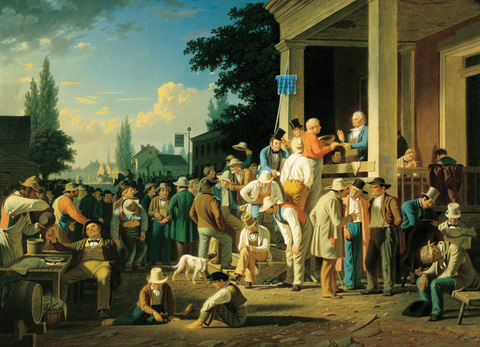
Image: The County Election, 1852 George Caleb Bingham; Source Saint Louis Art Museum

Monday, May 6, 2013

A One Hundred Trumpet Blast Wake-Up Call

When I think of a trumpet blowing, I envision an old episode of MASH when Major Frank Burns and Major Margaret Houlihan run the Army campy.  Under their rigid command, poor Radar is required to jolt awake the camp each morning with a frightful ramble of missed notes played on his near tuneless bugle.  What a wake up call.

The trumpet blast, though, served a purpose--it is a warning, a signal that change is coming, a reminder to be on alert.

For the Biblical Feast of Trumpets (otherwise known as Rosh Hashanah), the trumpet is used in a similar way.

Scripture says, On the first day of the seventh month you are to have a day of sabbath rest, a sacred assembly commemorated with trumpet blasts. Do no regular work, but present a food offering to the Lord” (Lev. 23:24-25).

This is the first of the "fall" feasts, and, in Jewish tradition, would begin with the blowing of the shofar, a trumpet of sorts carved out of the horn of a ram (or antelope).  On Rosh Hashanah, the shofar would be blown 100 times in a series, each series including "one long blast, three medium wails, and nine short bursts."

That's a lot of horn blowing.  The point, though, is to make sure everyone hears the sounding trumpet, for all to be warned and reminded of what is to come.  And, in the Jewish calendar, "what's to come" is Yom Kippur, the Day of Atonement ten days later, a day on which Israel's sins are judged for another whole year.  (Lev. 23:27-32). 

Imagine having ten days to prepare your soul for an annual meeting with the Lord.  You would likely spend those ten days doing everything in your power to make your soul clean, performing acts of kindness, and being on your best behavior.  As you might expect, those ten days between Rosh Hashanah (the blowing of the trumpets) and Yom Kippur (the Day of Atonement) are filled with much reflection, prayer, repentance, making right any wrongs, and repairing broken relationships.

The Talmud (a Jewish book of history, legend, & tradition) recounts that on Rosh Hashanah, three books are opened--one for the "utterly wicked," another for the "absolutely righteous," and a third for the "tweeners" who, as their name suggests, aren't completely evil or completely righteous.  For ten days, that last group's book is left open so they can get their accounts right with God and their names transferred into the Book of Life.1

However, those of us who are believers in Christ know that this tradition of doing good works to move one's name to the Book of Life is not the truth God intended when He established this Feast.  As Paul stated, "For it is by grace you have been saved, through faith—and this is not from yourselves, it is the gift of God— not by works, so that no one can boast. For we are God’s handiwork, created in Christ Jesus to do good works, which God prepared in advance for us to do" (Eph. 2:8-10).  In essence, Christians are definitely called upon to do works out of their love for Christ, but not because those works will earn them a ticket into heaven.  Only faith in Christ alone can transfer one from the kingdom of darkness to the kingdom of God's beloved Son (Col. 1:13).

What God did intend for His children to see in this Feast was how hopeless they were to save themselves, how they could never do enough to save themselves.  

 Likewise, the Feast was also to serve as a reminder that we must be ready because we know not when the day of salvation and judgment is.

Before that Great Day of Atonement when all mankind stands before the great white throne of judgment, there will be a trumpet blast telling us of Jesus' return to earth.  Scripture says,  in a moment, in the twinkling of an eye, at the last trumpet; for the trumpet will sound, and the dead will be raised imperishable, and we will be changed." (1 Cor. 15:52).

Additionally, in the end, there will be a great judgment with books.  John says, "And I saw the dead, great and small, standing before the throne, and books were opened. Another book was opened, which is the book of life. The dead were judged according to what they had done as recorded in the books" (Rev. 20:12).  Even Daniel saw "ten thousand times ten thousand stood before him. The court was seated, and the books were opened" (Dan. 7:10).

The difference between when Christ returns as Judge and King and the others Days of Atonement throughout the rest of history?  This time, we won't be given ten days to make our hearts right with Him.  This time, if our souls aren't ready, it will be too late and no amount of good deeds will make any difference.  One's present level of faith in Christ at the time of the trumpet blast is what will be judged.

As such, the Feast of Trumpets should remind us of our need to live in a constant state of readiness to meet our Lord.  That morning wake up call is coming.  Unlike when Radar played on his bugle, this time, the piercing blast will be perfectly in tune and will literally be the shot heard round the world.

For some, it will be a sound of much anticipated joy.  For others, it will be a sound of damnation.

Rabbi Derek Leman puts it so beautifully: "Rosh Hashanah is a reminder that we all have a limited time on earth.  Just like the 10 days between the blowing of the trumpets and Yom Kippur, we are all living in the meantime.  The only question is how we will spend it."2

(Click on the YouTube video above to hear just one "series" of blasts on a traditional shofar.)


Other Articles in this Jewish Feasts Series:
Positioning Passover Pronouns
Preparation Day: 'Go to Church' or Worship
Reorienting Our Lives: 50 Days From the Cross
Understanding the Jewish-ness of Jesus
The Truth About Passover


1.  Nadler, Sam. Feasts of the Bible. "Feast of Trumpets."  Video. Torrance: Rose P, 2011.
2.  Leman, Derek. Feast: Finding Your Place at the Table of Tradition.  Nashville: Lifeway, 2008: p. 62

Monday, April 29, 2013

Positioning Passover Pronouns

What amazes me about language is how one simple pronoun can change the meaning in an entire text. 

Imagine if I told my daughter, "Bring a necklace downstairs."  Using that pronoun, I'm likely to get anything from broken Mardi Gras beads to her church-only bling.  However, if I said "bring the necklace," this implies a specific piece we've already discussed.  If I change the pronoun again, saying "bring your necklace," my daughter would know not to raid my jewelry cabinet.

While this is a rather meaningless comparison, sometimes in Scripture, understanding God's true intent seriously comes down to a pronoun, or, rather the pronoun God chose.

Consider His instructions in Exodus to the Israelites concerning how they were to prepare the lamb for that first Passover sacrifice so the death angel passed over their household, leaving their firstborn sons untouched.  God said:

Speak to all the congregation of Israel, saying, ‘On the tenth of this month they are each one to take a lamb for themselves, according to their fathers’ households, a lamb for each household.  Now if the household is too small for a lamb, then he and his neighbor nearest to his house are to take one according to the number of persons in them; according to what each man should eat, you are to divide the lamb. Your lamb shall be an unblemished male a year old; you may take it from the sheep or from the goats" (Ex. 12:3-5).

Note the progression of pronouns--"a" to "the" to "your," working from general to specific.  It is a picture of what would have happened in this lamb selection process and, more importantly, a picture of Christ as our sacrificial lamb. 

For the Israelite, the lamb would initially be a lamb, merely one chosen for being without blemish from a thousand or more others in the fleecy flock .  Tradition shows this lamb would have then been brought into the household, living with the family from the tenth until the fourteenth day of the month.

Once selected, a lamb became the lamb the family would sacrifice at Passover.  For those Israelites back in Egypt on that first Passover, it was not a way of salvation from the curse of the firstborn's death but was the only way.  

Then, in five days' time, the lamb became your lamb, one that knew and responded to your voice, one that had come to trust you so that when you led it to slaughter at twilight on the fourteenth day, it went willingly with you.  

Imagine what this must have been like.  Place one hand on that lamb as its lifeblood pours out.  Take this active part in its death.  It is impossible to think of the animal as anything but your lamb since you are the cause of, the reason for, its death.  Its sacrifice saved you and your family.

Compare this symbolic series of actions with Jesus, whom John the Baptist referred to as "the Lamb of God who takes away the sin of the world!" (Jn. 1:29).

When He began His ministry, many believed Him to be merely a prophet.  Yet, He soon declared Himself not to be a lamb of God but the lamb, the door, the gate--the only way into heaven.

Gentle, meek, and mild, Jesus would have made His Triumphal Entry into Jerusalem with thousands of other lambs headed towards their Passover slaughter.  Yet, even in the midst of all those other lambs who would be sacrificed for the various families, He was the once-in-all-time perfect, spotless Lamb to be sacrificed for all mankind.

And in that instant, He became your lamb, dying for your sins, saving your soul with His sacrifice.

His Sacrifice became personal.  It wasn't just for mankind in general.  He died for you and you and you.

Just a few simple pronouns...yet, such a powerful message of what Jesus becomes to each of us who seek His face, repent, and accept His gracious, merciful gift of salvation.  He becomes our lamb.


Other Articles in this Jewish Feasts Series:
Preparation Day: 'Go to Church' or Worship
Reorienting Our Lives: 50 Days From the Cross
Understanding the Jewish-ness of Jesus
The Truth About Passover

Monday, April 22, 2013

Preparation Day: 'Go to Church' Or Worship?

Each Saturday evening while my three children slough off a pound of farm dirt from the day's hard play and labor, I begin my routine of preparation for the following Lord's day.  This night-before gathering to meet the next morning's mad dash started when the twins were infants.  With diapers, burp cloths, blankets, loveys, chew toys, an extra set of clothes, bottles, cheerio puffs, and pacifiers (all times two), I quickly learned this preparation made all the difference in whether our family arrived to worship or merely arrived at church.

Experience taught me it wasn't enough just to wake up early.  No matter how early I set the clock, Sunday morning would always exude a tinge of madness and, usually, more than a little chaos.  If milk is spilled, clothes are soiled before breakfast, or something essential is misplaced--this is the day it will happen.
 
That is why each Saturday before I slip my aching arches beneath the sheets, three sets of small shoes line up across the foot of the treadmill, each with matching shoes and stockings tucked in the toes.  Two crisply ironed shirts, two pairs of pressed dress slacks, and one equally wrinkle-free little lady dress swing back and forth immediately above those foot-covers.

By the back door sit a bag of after-church play clothes for dinner at Grand mama's house as well as a second bag filled with the lesson and necessary craft supplies for my four-year-old Sunday School class.

Without such preparation, I would either arrive at church in a foul mood or would throw up my hands in defeat.

As I've been working through the seven Biblical feasts, I've noticed a similar pattern in what God's chosen people did for many of these annual times of worship.

They prepared.  

In essence, preparation was the key to proper worship.

Consider the seven day Feast of Unleavened Bread, which begins the day after Passover.  Before its celebration, the Jewish people obeyed the command in Deuteronomy 16:3-4, which required the community to clean their homes of any products containing leaven: "Let no yeast be found in your possession in all your land for seven days." 

Such an action symbolized God's people separating themselves from sin, literally "removing" sin from their homes and, by extension, from their hearts.  That means any packaged foods in the house containing yeast, baking powder, baking soda, or sodium bicarbonate had to be removed.  Imagine going through all your cabinets, refrigerator, and freezer, and reading all the labels to determine if a leavening agent were in the pre-packaged food.  It's a bit like Spring Cleaning, and we all know how long that can take if done properly.

That's preparation for worship.

Even Jesus, Himself, spoke of the importance of preparation when discussing the Feast of Passover. He instructed Peter to "Go and make preparations for us to eat the Passover,"  and Peter replied, "Where do you want us to prepare for it?" (Lk. 22:8-9).

Scripture records Jesus giving a series of instructions that concluded with the words, "Make preparations there.”  The disciples then "left and found things just as Jesus had told them. So they prepared the Passover" (Lk. 22:12-13).

Four times in this short passage, Luke emphasized the preparation necessary for a proper celebration of this Feast of remembrance, this Feast of worship.
 
Another Feast that emphasizes preparation is the Feast of Trumpets, more commonly known in modern terminology as Rosh Hashanah.  This one-day Feast importantly announces the coming of Yom Kippur (The Day of Atonement) in ten days.  With the blast of the trumpet, the Jewish community begins to prepare their hearts for God's judgment.

As Rabbi Derek Leman says of this Holy Day, "The sins of the nation would be judged for another year on Yom Kippur.  On that day the high priest would bring blood into the holiest place that no one else entered.  And every year the question was the same: Would God receive Israel's offering?  Would He grant mercy and grace another year?...Traditionally the period between Rosh Hashanah and Yom Kippur [The Day of Atonement] is called 'The Ten Days of Awe.'  That week and a half is a time for self-reflection, to repair relationships, and to pray in light of one's own standing before God.  These are days of repentance" (p. 57).

Again, the Feast and Holy Day emphasized preparation for worship.

Do you see a pattern here in God's call for His people to worship?

It wasn't just a "Hey, mark your calendar and show up on X day" kind of event.  Instead, each Feast, each Holy Day was about preparing one's heart (and home, by extension) for worship.

Compare this to our generation.  As a general rule, we don't prepare for worship.  Instead, we waltz in on Sunday morning, expecting to receive God's blessing, to receive an enlightened message from His Word, to feel His Spirit move within......and all without really preparing our hearts for worship.

Worship isn't just about showing up at a certain place and time.  True worship should involve us continually preparing our hearts for meeting with God.

He is holy.  He is worthy of such preparation.


Other Articles in this Jewish Feasts Series:
Reorienting Our Lives: 50 Days From the Cross
Understanding the Jewish-ness of Jesus
The Truth About Passover

Source: Leman, Derek. Feast: Finding Yourself at the Table of Tradition. Nashville: Lifeway P, 2008: p.57.

Sunday, April 14, 2013

Reorienting Our Lives: 50 Days From the Cross

Last week, I concluded with the thought that "We need to know the Jesus of Scriptures.  However, to understand Him fully, we must not reject His Jewish-ness but must, instead, seek to understand what it has to teach us more about this Savior whom we serve."

In an effort to learn more about Jesus Christ, this blog is working through a series on the seven Feasts the Jews of Moses' day were commanded in Leviticus 23 to observe.  The whole purpose is not to burden anyone with more rules and regulations concerning their walk with the Lord but, instead, to reveal to us the care God took when creating those Feasts and how He was foreshadowing Messiah through the Feasts' symbolism.  

Over the past few weeks, we have looked back to Passover and two Pentecost celebrations in Exodus and Acts.  This week, I want to look at two interesting (and symbolic) commands concerning the celebration of Pentecost. 

First, according to Scripture, The Feast of Weeks (or Pentecost) holds no specific date on the calendar.   In fact, it's the only Feast with no set date.  Instead, God said to Moses, "From the day after the Sabbath, the day you brought the sheaf of the wave offering, count off seven full weeks.  Count off fifty days up to the day after the seventh Sabbath" (Lev. 23:15-16).

If one wished to celebrate Pentecost, he had to count forwards fifty days from Passover.  For fifty days, God's people were to be looking back to the sacrifice of the lamb and the ensuing redemption of life through that sacrifice.  

Think of the symbolism!  For those of us who understand Christ to be Messiah, our once and for all sacrificial lamb, God is showing us that our lives literally "begin" with Christ's sacrifice at Passover.  

There can be no Pentecost without Passover--both literally and figuratively.  There can be no Pentecost harvest of souls or gift of the Holy Spirit (as happened at in Acts 2) without Messiah's sacrifice at Passover.

Eternal life begins with death on the cross.  Pentecost begins 50 days earlier with Passover.

In essence, the Passover sacrifice is the very foundation of life, itself as opposed to death found in sin. God's plan in making His people count forward fifty days was for them to "reorient" themselves to Messiah's sacrifice at Passover by looking backwards.

How beautiful a picture of how our lives should be, reoriented to where we are constantly looking back to the cross as the start of our new life in Him.

A second interesting command concerning Pentecost was the sacrifice the people were to bring to God. The people were to "bring two loaves made of two-tenths of an ephah of the finest flour, baked with yeast, as a wave offering of firstfruits to the Lord" (Lev. 23:17).

This seems odd, especially since in Scripture, Leaven (yeast) is typically symbolic of sin.    Jesus  warned His disciples of the Pharisees' sinfulness: "Be on your guard against the yeast of the Pharisees and Sadducees" (Matt. 16:6).  Paul even later uses the image of leaven as sin, warning his readers, "Don’t you know that a little yeast leavens the whole batch of dough? Get rid of the old yeast, so that you may be a new unleavened batch—as you really are. For Christ, our Passover lamb, has been sacrificed. Therefore let us keep the Festival, not with the old bread leavened with malice and wickedness, but with the unleavened bread of sincerity and truth" (1 Cor. 5:6-8).

Yet, for the wave offering of Pentecost, God called upon His people to give two loaves made with leaven.

Here, too, the symbolism is important.  Through the bread, God is giving a picture of us, as people full of sin despite our best attempts at righteousness.  Just as He asked the people of Israel to bring their leaven-filled loaves to Him, He beckons us to come as we are to Him.  Full of sinful leaven and in a completely hopeless state, He accepts us with our sin...but only because we are looking back to Messiah, only because we are covered by that sacrifice fifty days earlier at Passover.

Additionally, Professor Sam Nadler argues that the required sacrifice of two loaves (versus one) also provide a symbolic picture of us in Christ, as well.  Nadler says the two loaves represent Jew and Gentile together in the body of Christ, both united but still diverse.  Thus, there is unity but not uniformity in Christ.*

I don't know about you, but I find God's attention to detail in these Feasts comforting, humbling, and awe-inspiring, all at the same time.  Seeing His promises fulfilled over and over shows just how much He loves me.  Honestly, it's baffling.  But it makes me love Him all the more.


*Feasts of the Bible. Video. Torrance: Rose P, 2011.
Image: Breathtaking "Pentecost" frontal at Wells Cathedral in the U.K.