The typical lazy feel of Saturday mornings was shattered as I rushed to prepare everything for the weekly international meal we would be eating that evening. The food processor quickly shredded eight cups of sweet potatoes that joined a fluffy mound of brown sugar and toasted pecans in one crock pot while the pound of black eyed peas I had been soaking overnight combined with bacon and onions to fill a second crock pot.
Meanwhile, the rice cooker counted down to its distinctive ding as the chicken marinated in freshly squeezed lime juice. Around me, the air filled with competing sweet and savory aromas of the Bahamas until the scent of a golden brown pineapple pie overpowered them all as it emerged from the oven.
An hour later, I escaped the kitchen to spend the afternoon off the farm with my children while adopted daughter went to a wedding shower and husband set off to mow the lawn.
At day's end, however, all six of us came back together as we do most every evening--gathered round the table to share a meal with each other. It's a time for catching up with one another, sharing the highs (or lows) of our days, a time to breathe out the frustrations of the day and simply give thanks for the togetherness.
Several times in Scripture, God emphasizes the shared meal as a time of togetherness intended to foster relationship not simply with each other but with Him.
When speaking of the Promised Land, Moses tells the Israelites, "But you shall seek the Lord at the place which the Lord your God will choose from all your tribes, to establish His name there for His dwelling, and there you shall come. There you shall bring your burnt offerings, your sacrifices, your tithes, the contribution of your hand, your votive offerings, your freewill offerings, and the firstborn of your herd and of your flock. There also you and your households shall eat before the Lord your God, and rejoice in all your undertakings in which the Lord your God has blessed you" (Deut. 12:5-7).
There, in the midst of rules about worship, sacrifices and burnt offerings, Moses emphasizes that "you and your households shall eat before the Lord your God." Notice this eating is done in community, not alone. It is also done in conjunction with rejoicing--giving thanks!
This "eat before the Lord" is a concept repeated multiple times in Scripture. It's not, however, about the meal, itself, or the need to replenish our bodies with food. Instead, coming to a communal table to share in the meal is about relationship--about needing each other--as much as it is about thanksgiving, being mindfully thankful for what God has given us.
Earlier at Mt. Sinai, Scripture demonstrates the meal as relationship. In Exodus 24 after the people of Israel entered into a covenant with God, the entire congregation agreeing to obey the Law of the Lord, Scripture says "Moses went up with Aaron, Nadab and Abihu, and seventy of the elders of Israel, and they saw the God of Israel; and under His feet there appeared to be a pavement of sapphire, as clear as the sky itself. Yet He did not stretch out His hand against the nobles of the sons of Israel; and they saw God, and they ate and drank" (Ex. 24:9-11).
This eating was done, quite literally, before the Lord. Obviously, it had nothing to do with consuming calories for one's health. Instead, the meal was a way to commemorate the sealed covenant relationship between God and Israel. And though Scripture doesn't record it, I imagine there was a good bit of rejoicing over the blessings of God.
The New Testament as well speaks of the shared meal in terms of relationship. While the Lord's Supper is probably the meal that springs most easily to mind, there are numerous other instances of the communal table as a symbol for relationship.
In John's inaugural vision, Jesus calls the Church at Laodicea to the table of fellowship, saying, "'Look! I
stand at the door and knock. If you hear my voice and open the door, I
will come in, and we will share a meal together as friends'"(Rev. 3:20).
Later, John tells us that history is moving towards one great table of fellowship, thanksgiving, and rejoicing: "'Let us rejoice and be glad and give the glory to Him, for the marriage of the Lamb has come and His bride has made herself ready.' It was given to her to clothe herself in fine linen, bright and clean; for the fine linen is the righteous acts of the saints. Then he *said to me, 'Write, 'Blessed are those who are invited to the marriage supper of the Lamb''" (Rev. 19:7-9).
The focus of the meal is on rejoicing in the Lord our God. It is on being thankful for His many blessings. It is on our relationship with Him.
Though our culture seems to have less and less time for such a luxury as a shared meal round a table (except for on holidays), Christians should strive to reclaim the family dinner table as much as is possible. No matter whether it's frozen fish sticks and fries or a four-course meal--it is in this seated position around the table where we can teach our children about the Lord, can strengthen our relationships with each other, and can strengthen our relationship with God as we seek to make the meal a time to mindfully rejoice in unity and give communal thanks for His blessings.
Showing posts with label family. Show all posts
Monday, July 27, 2015
Monday, May 13, 2013
Habits of the Heart: A Look at 1830s America
Alexis de Tocqueville left France for America in 1831. His quest? To determine why democracy had succeeded in the United States so he might apply those secrets back in his homeland. What he found was quite enlightening.
In 1835, Tocqueville published Democracy in America, which identified America's success as being grounded in Christianity. He understood that many were not Christians in early American culture, but the Christians who were genuine made a huge impact of the rest of society. The difference between then and now is how those Christians lived compared to modern-day Christians.
Chris Brauns in his latest Bound Together summarizes Tocqueville's discovery:
"'Tocqueville marveled at the relative absence of government from American life and the corresponding vitality of civil society, especially when compared to the state's all-pervasive presence in his native France.' Tocqueville believed it was Christian values and virtues, what he called 'habits of the heart,' rather than the involvement of government that made for responsible citizens. This, he suggested, was the bedrock of the American experiment.
Tocqueville was not naive about the spirituality of America. He understood that not every citizen was a professing Christian. He was aware of the fact that even among those who professed faith in Christ there was still great hypocrisy. Even so, he noted, 'Revolutionaries in America are obliged to profess a certain public respect for Christian morality and equity, so that it is not easy for them to violate the laws when those laws stand in the way of their own designs. And even if they could overcome their own scruples, they would still be held in check by the scruples of their supporters.'
Tocqueville was especially impressed by the effectiveness of American homes in passing along Christian 'habits of the heart,' and the strength of American homes began with a high regard for marriage: 'Of all the countries in the world, America is surely the one in which the marriage bond is most respected, and in which people subscribe to the loftiest and most just ideal of conjugal happiness.'
Tocqueville believed that mothers, in particular, deserved high praise for teaching Christian values to their children...Tocqueville wrote, 'If someone were to ask me what I think is primarily responsible for the singular prosperity and growing power of [Americans], I would answer that it is the superiority of their women.'
Christian 'habits of the heart,' instilled by godly parents living together in committed marriages, had given rise to a citizenry with a strong sense of civic responsibility and solidarity with one another." (p. 166).
The Christians from two centuries ago were salt and light in their nation. They didn't withdraw completely from the world or throw up their hands in bitter, what-can-I-do-anyway defeat. They didn't strive to be politically correct at all costs so as not to offend someone, to turn a blind eye or gently re-label sin a "choice."
The effects of early American Christianity were similar to a circle of dominoes, one causing another and then another to fall, although in this time period, they fell in a positive way.
Consider the links mentioned in the above quotation. Early American government was small and not intrusive because Christian morality was high (so high that even non-Christians stayed in line). Christian morality was high because marriages were of utmost importance, making the home stable. Because marriages were of utmost importance, parents were able not just to teach Christian values in the home but to live out those Christian values in front of their children. Christian values, then, became ingrained in the children, thereby making Christian morality high in the overall country. See the loop?
America at its greatest begins with mothers and fathers. It begins in the home. It begins with Christians teaching and living out Biblical morality in front of their children. It begins with Christians refusing to lock themselves inside their churches and homes and, instead, getting out into the world to let their light shine before men.
I'm not pointing a finger. I'm speaking to myself, too. There's nothing I'd rather do than stay on my farm, spend time with my family, or worship at church with my spiritual family. Those are safe places that encourage me in my Christian walk. But it's not just about me. It is about a nation, a world full of lost people making wrong, sinful choices...and many of them have no idea they're doing anything wrong.
With Mother's Day just yesterday, I can't help but take Tocqueville's analysis of America and say, if we want our country back, the buck stops with the Christian mother and father. We Christian parents must (1) save our families at all costs. Divorces because of 'irreconcilable differences' or 'we just fell out of love' must stop with us. And (2) we parents must teach and live out Christian values to and before our children.
Like the Israelites in the Old Testament, we are literally one generation away from godliness or godlessness.
(I know this is a bit different from my usual post, but the last chapter in Brauns' book has really convicted me, staying forefront in my mind an entire week. It has made me reevaluate my role as a Christian mother.)
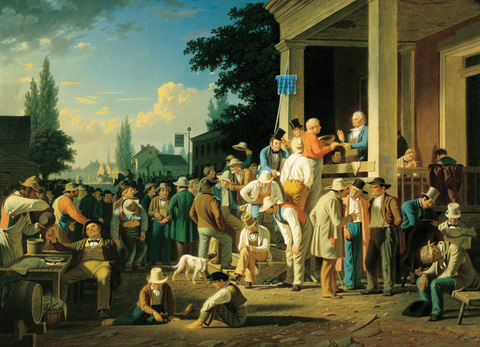
Image: The County Election, 1852 George Caleb Bingham; Source Saint Louis Art Museum
In 1835, Tocqueville published Democracy in America, which identified America's success as being grounded in Christianity. He understood that many were not Christians in early American culture, but the Christians who were genuine made a huge impact of the rest of society. The difference between then and now is how those Christians lived compared to modern-day Christians.
Chris Brauns in his latest Bound Together summarizes Tocqueville's discovery:
"'Tocqueville marveled at the relative absence of government from American life and the corresponding vitality of civil society, especially when compared to the state's all-pervasive presence in his native France.' Tocqueville believed it was Christian values and virtues, what he called 'habits of the heart,' rather than the involvement of government that made for responsible citizens. This, he suggested, was the bedrock of the American experiment.
Tocqueville was not naive about the spirituality of America. He understood that not every citizen was a professing Christian. He was aware of the fact that even among those who professed faith in Christ there was still great hypocrisy. Even so, he noted, 'Revolutionaries in America are obliged to profess a certain public respect for Christian morality and equity, so that it is not easy for them to violate the laws when those laws stand in the way of their own designs. And even if they could overcome their own scruples, they would still be held in check by the scruples of their supporters.'
Tocqueville was especially impressed by the effectiveness of American homes in passing along Christian 'habits of the heart,' and the strength of American homes began with a high regard for marriage: 'Of all the countries in the world, America is surely the one in which the marriage bond is most respected, and in which people subscribe to the loftiest and most just ideal of conjugal happiness.'
Tocqueville believed that mothers, in particular, deserved high praise for teaching Christian values to their children...Tocqueville wrote, 'If someone were to ask me what I think is primarily responsible for the singular prosperity and growing power of [Americans], I would answer that it is the superiority of their women.'
Christian 'habits of the heart,' instilled by godly parents living together in committed marriages, had given rise to a citizenry with a strong sense of civic responsibility and solidarity with one another." (p. 166).
The Christians from two centuries ago were salt and light in their nation. They didn't withdraw completely from the world or throw up their hands in bitter, what-can-I-do-anyway defeat. They didn't strive to be politically correct at all costs so as not to offend someone, to turn a blind eye or gently re-label sin a "choice."
The effects of early American Christianity were similar to a circle of dominoes, one causing another and then another to fall, although in this time period, they fell in a positive way.
Consider the links mentioned in the above quotation. Early American government was small and not intrusive because Christian morality was high (so high that even non-Christians stayed in line). Christian morality was high because marriages were of utmost importance, making the home stable. Because marriages were of utmost importance, parents were able not just to teach Christian values in the home but to live out those Christian values in front of their children. Christian values, then, became ingrained in the children, thereby making Christian morality high in the overall country. See the loop?
America at its greatest begins with mothers and fathers. It begins in the home. It begins with Christians teaching and living out Biblical morality in front of their children. It begins with Christians refusing to lock themselves inside their churches and homes and, instead, getting out into the world to let their light shine before men.
I'm not pointing a finger. I'm speaking to myself, too. There's nothing I'd rather do than stay on my farm, spend time with my family, or worship at church with my spiritual family. Those are safe places that encourage me in my Christian walk. But it's not just about me. It is about a nation, a world full of lost people making wrong, sinful choices...and many of them have no idea they're doing anything wrong.
With Mother's Day just yesterday, I can't help but take Tocqueville's analysis of America and say, if we want our country back, the buck stops with the Christian mother and father. We Christian parents must (1) save our families at all costs. Divorces because of 'irreconcilable differences' or 'we just fell out of love' must stop with us. And (2) we parents must teach and live out Christian values to and before our children.
Like the Israelites in the Old Testament, we are literally one generation away from godliness or godlessness.
(I know this is a bit different from my usual post, but the last chapter in Brauns' book has really convicted me, staying forefront in my mind an entire week. It has made me reevaluate my role as a Christian mother.)
Image: The County Election, 1852 George Caleb Bingham; Source Saint Louis Art Museum
Labels:
Alexis de Tocqueville,
Bound Together,
Chris Brauns,
divorce,
family,
morality,
salt and light,
values
Sunday, November 25, 2012
When Your Family Tree is Sick: Part II
These are the people I am most thankful for. My husband. My parents. My children.
Given the chance, I would willingly exchange my own life for theirs, and in many small ways, I do that already each time I devote minutes, hours, days, and years to express my love to them. A true love is sacrifice. Yet, that love can only go so far, do so much.
Last week, we began a two-part glimpse into a Christian's role in others' salvation.
In Part I, we looked at those in our family tree who are hopelessly lost and how we are unable to save them with either our own righteous, loving obedience to God or our prayers on their behalf. Although we who are Christians want to save the entire world and especially our loved ones, each person is ultimately accountable for his or her own soul.
As God said through the prophet Ezekiel, "'if a country sins against Me by committing unfaithfulness, and I stretch our My hand against it...even though these three men, Noah, Daniel, and Job were in its midst, by their own righteousness they could only deliver themselves,' declares the Lord GOD" (Ez. 14:13-14)*.
Part II of the question asks what the Christian's response should be if he can't pray someone into heaven. Does he just give up and stop praying for them entirely?
In the previous verse and in verse twenty of the same chapter from Ezekiel, God mentions three pillars of faith who give insight into this part of the question. Noah, Daniel, and Job interceded for those around them.
Noah is recorded as "a righteous man, blameless among the people of his time, and he walked faithfully with God" (Gen. 6:9). Later, Peter refers to him as "a preacher of righteousness" (Gen. 6:9, 2 Pet. 2:5). While I don't find a specific example of Noah praying for the people before the flood, the word "preacher" in the previous verse means "God's ambassador, and the herald or proclaimer of the divine word"**
Throughout The Old Testament, a pattern appears of God's ambassadors interceding for the unrighteous after they receive a divine warning of impending wrath. Moses repeatedly interceded for Israel while Abraham interceded for the cities of Sodom and Gomorrah. Surely after God's warning and throughout the 90+ years it took him to build the ark, Noah not only shared with everyone what was going to happen but also prayed to God for their deliverance.
Sadly, as history records, not one repented; not one was delivered.
Unlike Noah, in the cases of Daniel and Job, it is more obvious that they interceded for their people.
In the story of Job, Scripture specifically records him praying for family and friends.
For his children, he continually prayed: "Job would send and consecrate them, rising up early in the morning and offering burnt offerings according to the number of them all; for Job said, 'Perhaps my sons have sinned and cursed God in their hearts.' Thus Job did continually" (Job. 1:5).
Job also "prayed for his friends" (Job 42:10). But neither his children's deliverance nor his friends' deliverance came through his intercession.
Instead, his friends' deliverance came from their own actions of offering a burnt offering in repentance before the Lord. As the Lord said to them, "My servant Job will pray for you. For I will accept him so that I may not do with you according to your folly" (Job. 42: 8). They obeyed and were spared by their own actions.
Daniel, as well, prayed for his people.
In a quite lengthy prayer, Daniel "prayed to the Lord my God and confessed and said, 'Alas, O Lord we. . .have sinned, committed iniquity, acted wickedly and rebelled, even turning aside from Your commandments and ordinances. Moreover, we have not listened to Your servants the prophets, who spoke in Your name to our kings, our princes, our fathers and all the people of the land" (Dan. 9:4-6).
He requested God to relent in His wrath on Israel: "let now Your anger and Your wrath turn away from Your city Jerusalem, Your holy mountain; for because of our sins and the iniquities of our fathers, Jerusalem and Your people have become a reproach to all those around us"
Yet, even Daniel could not save the city of Jerusalem because of the people's sin.
What, then, should a Christian's response be?
The answer is clear--the Word of God demonstrates that the righteous must still stand in the gap, must still intercede for those who do not know Christ.
In the New Testament, the apostle Paul encouraged us to do likewise: "First of all, then, I urge that entreaties and prayers, petitions and thanksgivings, be made on behalf of all men" (1 Tim 2:1).
May we be able to say with conviction that "my heart’s desire and my prayer to God for them is for their salvation" (Rom 10:1).
*I wanted to note that some commentators believe that the Daniel mentioned here is not the same man who wrote the book of Daniel. Although I humbly disagree, the idea that the righteous intercede for others is a sound tenet found throughout scripture. I can't help but believe if this text does refer to another Daniel, he, too, would have interceded for his people.
**Blue Letter Bible Online.
Labels:
Abraham,
Daniel,
family,
intercession,
Job,
prayer,
righteousness,
salvation,
stand in the gap
Monday, November 19, 2012
When Your Family Tree is Sick: Part I
What do you do when your family tree is filled more with people who want nothing to do with God than with people who want to serve Him? Can you save them by your own prayers and righteousness? And if not, do you just give up?
These are honest questions I have asked God more than once.
My immediate family is devoted to the Lord. From my Grandfather's devotion to the Lord came four daughters who loved Him, three of whom are married to Godly husbands who helped those daughters raise seven grandchildren to serve Him as well. Slowly, these seven grandchildren are marrying, seeking to choose Godly spouses and create another Christan home to nurture their children.
Presently, there are seventeen of us this side of eternity, plus my small children and a few potential mates. When we are together, it seems like a large group serving the Lord.
But all I have to do is trace back and follow any other branch in the family tree to see faithlessness, blood after blood going another direction, seeking after their own pursuits.
When I look at the whole tree, I see how tiny our healthy little branch truly is. The bulk of my family tree is infected to the marrow, sick with sin. My heart grieves over my relatives' souls.
Today's article will be part of a two-part post since it's a two-pronged question. First, can my righteousness save my relatives? And secondly, if it can't, should I just give up praying for them?
For the first part--can my obedience to God, my prayer for others--can it save their souls?
In Ezekiel 14, God says no. He tells the prophet, " 'if a country sins against Me by committing unfaithfulness, and I stretch our My hand against it...even though these three men, Noah, Daniel, and Job were in its midst, by their own righteousness they could only deliver themselves,' declares the Lord GOD" (Ez. 14:13-14)*.
In other words, not even the most righteous pillars of faith could save another person from the pits of hell's judgment.
Throughout the remainder of the chapter, God methodically presents one method of destruction after another--famine, wild beasts, sword, and plague. With each of these four judgments, He repeats the same phrasing about deliverance, emphasizing that one can only save his/her own soul, not the souls of others...not even the souls of their children.
God soberly states, "even though Noah, Daniel and Job were in its [the country's] midst...they could not deliver either their son or their daughter. They would deliver only
themselves by their righteousness" (Ez. 14:20).
These verses together emphasize the principle of personal accountability. God doesn't let us shift the blame and evade responsibility for our actions.
Four chapters, later, Ezekiel quotes a common proverb of his day: "The fathers eat the sour grapes, But the children's teeth are set on edge" (v. 2). In other words, the Israelites were doing much what our culture does today--blaming their parents. Here, the proverb means that because their fathers had sinned, they inherited their fathers' bitterness or punishment by having to live in exile in Babylon.
The problem is that in shifting the blame to their parents, they weren't acknowledging their own personal guilt before God, and God wasn't going to have it.
The entirety of Chapter 18 explains what the righteous man with the unrighteous father, the unrighteous man with the righteous father, and so on can expect from God.
He concludes, "The son will not bear the punishment for the father's iniquity, nor will the father bear the punishment for the son's iniquity; the righteousness of the righteous will be upon himself, and the wickedness of the wicked will be upon himself" (Ez. 18:20).
Personal accountability.
God ends with a plea to His people: "Therefore I will judge you, O house of Israel, each according to his conduct,' declares the Lord GOD. 'Repent and turn away from all your transgressions, so that iniquity may not become a stumbling block to you. Cast away from you all your transgressions which you have committed and make yourselves a new heart and a new spirit! For why will you die, O house of Israel?...Therefore, repent and live'" (Ez. 18:30-32).
It hurts my heart, knowing I cannot bring my family to salvation. The New Testament is clear that that is a work of the Holy Spirit.
No matter how much I pray for them, my prayers, my righteousness cannot save my children. They cannot save my mother, my father, my husband.
Next week, we will discuss in this space what a Christian's response should be if her righteousness cannot save another.
But for now, Ezekiel 18 says we each must make a choice--life or death. Yes, it's really that simple.
Life in Christ or death without Him.
God is asking us, "For why will you die, __________? Therefore, repent and live."
These are honest questions I have asked God more than once.
My immediate family is devoted to the Lord. From my Grandfather's devotion to the Lord came four daughters who loved Him, three of whom are married to Godly husbands who helped those daughters raise seven grandchildren to serve Him as well. Slowly, these seven grandchildren are marrying, seeking to choose Godly spouses and create another Christan home to nurture their children.
Presently, there are seventeen of us this side of eternity, plus my small children and a few potential mates. When we are together, it seems like a large group serving the Lord.
But all I have to do is trace back and follow any other branch in the family tree to see faithlessness, blood after blood going another direction, seeking after their own pursuits.
When I look at the whole tree, I see how tiny our healthy little branch truly is. The bulk of my family tree is infected to the marrow, sick with sin. My heart grieves over my relatives' souls.
Today's article will be part of a two-part post since it's a two-pronged question. First, can my righteousness save my relatives? And secondly, if it can't, should I just give up praying for them?
For the first part--can my obedience to God, my prayer for others--can it save their souls?
In Ezekiel 14, God says no. He tells the prophet, " 'if a country sins against Me by committing unfaithfulness, and I stretch our My hand against it...even though these three men, Noah, Daniel, and Job were in its midst, by their own righteousness they could only deliver themselves,' declares the Lord GOD" (Ez. 14:13-14)*.
In other words, not even the most righteous pillars of faith could save another person from the pits of hell's judgment.
Throughout the remainder of the chapter, God methodically presents one method of destruction after another--famine, wild beasts, sword, and plague. With each of these four judgments, He repeats the same phrasing about deliverance, emphasizing that one can only save his/her own soul, not the souls of others...not even the souls of their children.
God soberly states, "even though Noah, Daniel and Job were in its [the country's] midst...they could not deliver either their son or their daughter. They would deliver only
themselves by their righteousness" (Ez. 14:20).
These verses together emphasize the principle of personal accountability. God doesn't let us shift the blame and evade responsibility for our actions.
Four chapters, later, Ezekiel quotes a common proverb of his day: "The fathers eat the sour grapes, But the children's teeth are set on edge" (v. 2). In other words, the Israelites were doing much what our culture does today--blaming their parents. Here, the proverb means that because their fathers had sinned, they inherited their fathers' bitterness or punishment by having to live in exile in Babylon.
The problem is that in shifting the blame to their parents, they weren't acknowledging their own personal guilt before God, and God wasn't going to have it.
The entirety of Chapter 18 explains what the righteous man with the unrighteous father, the unrighteous man with the righteous father, and so on can expect from God.
He concludes, "The son will not bear the punishment for the father's iniquity, nor will the father bear the punishment for the son's iniquity; the righteousness of the righteous will be upon himself, and the wickedness of the wicked will be upon himself" (Ez. 18:20).
Personal accountability.
God ends with a plea to His people: "Therefore I will judge you, O house of Israel, each according to his conduct,' declares the Lord GOD. 'Repent and turn away from all your transgressions, so that iniquity may not become a stumbling block to you. Cast away from you all your transgressions which you have committed and make yourselves a new heart and a new spirit! For why will you die, O house of Israel?...Therefore, repent and live'" (Ez. 18:30-32).
It hurts my heart, knowing I cannot bring my family to salvation. The New Testament is clear that that is a work of the Holy Spirit.
No matter how much I pray for them, my prayers, my righteousness cannot save my children. They cannot save my mother, my father, my husband.
Next week, we will discuss in this space what a Christian's response should be if her righteousness cannot save another.
But for now, Ezekiel 18 says we each must make a choice--life or death. Yes, it's really that simple.
Life in Christ or death without Him.
God is asking us, "For why will you die, __________? Therefore, repent and live."
Labels:
Daniel,
family,
family tree,
Job,
Noah,
prayers,
righteousness,
salvation
Subscribe to:
Posts (Atom)