One year for his birthday, my brother received a camouflaged, one-person pop-tent. I thought it was wonderful...for a play-house, that is. Hot summer afternoons were spent lining the tent's floor with old carpet samples and serving mud with acorn pies in upside-down Frisbee platters.
My brother, however, wanted to actually camp out in the backyard in that tent. No way was I interested.
To this day, the thought of sleeping outside in a paper-thin shelter terrifies me. Coyotes, raccoons, and wild boar, o my! Their teeth, their claws, their tusks!
Unlike the children of Israel who camped forty years in the desert, I know the security of locked windows, sealed doors, and the safety of an alarm system. Camping outdoors just doesn't hold any allure. I'm quite content to experience my closeness with God's creation during the daylight hours and from a front porch swing in the evenings.
Yet, the seventh and final feast commanded in Leviticus 23 involves just that--camping out.
Sukkot. The Feast of Tabernacles, also called the Feast of Booths, is a seven-day celebration at the end of the harvest season, similar to our Thanksgiving.
God commanded, "On the first day you are to take branches from luxuriant trees—from palms, willows and other leafy trees—and rejoice before the Lord your God for seven days. Live in temporary shelters for seven days: All native-born Israelites are to live in such shelters so your descendants will know that I had the Israelites live in temporary shelters when I brought them out of Egypt. I am the Lord your God” (Lev. 23:40, 42-43).
Here, God makes it clear that for the duration of the Feast, His people were to leave the security of their homes and dwell in temporary shelters made from tree branches covered with palm leaves. According to Rabbi Derek Leman in Feast, "The rabbis say that you have to leave holes in the roof large enough to see the stars shining through" (p. 99).
This is a Feast focused on God and man dwelling together, about man leaving the security of his man-made walls and living outdoors in flimsy "booths" where he must rely fully on God for protection.
John 1:14 says "The Word became flesh and took up residence among us. We observed His glory, the glory as the One and Only Son from the Father, full of grace and truth."
That word "residence"? It is also interpreted as "tabernacled." In other words, when Messiah came to earth as a tiny babe, He tabernacled among us, God residing with man in a human body that seemed like those palm-branch-covered booths--flimsy, frail, easily crucified on a cross. Yet, while He was fully human, He was also fully God, fully our protection.
What's even more interesting for the believer in Jesus is that in Scripture, the prophet Zechariah says that all will celebrate this feast in the New Jerusalem, in the new kingdom where Jesus reigns as king: " Then the survivors from all the nations that have attacked Jerusalem will go up year after year to worship the King, the Lord Almighty, and to celebrate the Festival of Tabernacles" (Zech. 14:16).
All the nations (even those against God) will come to give thanks to Him for His provision. Those nations who refuse will be denied rain for the next year, reminiscent of Elijah's prophecy against a defiant King Ahab.
For those who love Him, God promises that in that day, He will be a tabernacle over Israel: "Then the Lord will create over all of Mount Zion and over those who assemble there a cloud of smoke by day and a glow of flaming fire by night; over everything the glory will be a canopy. It will be a shelter and shade from the heat of the day, and a refuge and hiding place from the storm and rain" (Is. 4:5-6).
Isn't that beautiful? God, Himself, as our physical shelter, our protection, our refuge?
God took much care to show us that every good thing comes from Him, that He is our ever-present refuge... even in the wilderness periods of our lives.
Image: Preparing for Sukkot in Jerusalem.
Other Articles in this Jewish Feasts Series:
When The Books Are Closed: A Look at Yom Kippur
A One Hundred Trumpet Blast Wake-Up Call
Positioning Passover Pronouns
Preparation Day: 'Go to Church' or Worship
Reorienting Our Lives: 50 Days From the Cross
Understanding the Jewish-ness of Jesus
The Truth About Passover
Sunday, June 23, 2013
Sunday, June 16, 2013
My Father's Hands
The roughness of working the land has started to give way to the softness of age, but the strength is still there because of constant labor. Still, these are the same hands that have provided for me, protected me, and led me to the path I now walk.
On Father's Day, I joined with a nation that gives thanks to earthly fathers. It's important that we honor these great men. What's more important, though, is to emphasize their continued importance in a nation where 19.7 million children are growing up in single-mother homes.
Men are important. Fathers are important.
And yet, what is a father to be? How can men seek to become stronger, better fathers who leave a positive, Christ-filled legacy for their children? Or is it just too late?
Author Douglas Wilson says, "We learn what tangible fathers are supposed to be like by looking to the intangible Father. And we look to Him by looking at Jesus, the One who brings us to the Father" (p. 192).
The very essence of Christ was knit with the Father. The logical outgrowth of such an intimate relationship is that the Father's nature was daily demonstrated through His Son.
Thus, to be a good earthly father is to mirror the eternal Father. To mirror the eternal Father is to mirror Christ in one's heart, mind, speech, and actions.
Wilson concludes that one unifying characteristic both Christ and the eternal Father share is that of generosity. He summarizes: God the Father is "generous with His glory (1:14), with His tasks (5:18), with His protection (10:28-32), with His home (14:1-2), and with His joy (16:23-24). The Father gives (3:34-36). The Father gives His Son (3:16; 18:11); the Father gives His Spirit (14:16-17); the Father gives Himself (14:22-24)....Christ images the Father, and we are to image Christ. The way to do that is clearly to be open-handed" (p. 196-197).
This call to open-handed generosity does not mean that fathers are to give their children everything those little hearts desire. Even so, this generosity does involve a giving of the tangible sort--a giving of financial support, of physical protection, of a roof overhead. But it is more than that. It is more a generosity of self.
A father is generous with his full attention. "Full attention" does not mean having a conversation with a child when one eye is on the TV, one finger on the computer keyboard, or one ear to the cell phone. The eternal Father listened--really listened--to Jesus. The Son never questioned whether His Father was truly listening or just nodding His holy head even though His ears were really closed.
Before raising Lazarus from the dead, Christ said aloud, "'Father, I thank You that You have heard Me. I knew that You always hear Me; but because of the people standing around I said it, so that they may believe that You sent Me'" (Jn. 11:41). This kind of listening lets children know their ideas are important, they are important.
A father is generous with his example. Like it or not, a father must be ever-conscious that every word and deed is an example for his child. Christ said, "the Son can do nothing of Himself, unless it is something He sees the Father doing; for whatever the Father does, these things the Son also does in like manner" (Jn. 10:19). To expect a child to do what the father does not is like expecting a child to fluently speak a language not spoken daily in the household. Whatever daily "language" a parent's actions speak, that is the language he is teaching that child. It may be a language of impatience, of greed, of apathy, of anger, of irreverence, of selfishness. Or it may be a language of love, kindness, goodness, gentleness, self control, respect, peace.
A father is generous with his teaching. Most importantly, a father is generous with his teaching about God. Many in my generation know of God. They were raised in church. A good many even claim to be Christians, themselves. Yet, too many fathers (and mothers) in this same generation are choosing to not raise their children in church. Christ said, "It is written in the prophets, ‘ And they shall all be taught of God.’ Everyone who has heard and learned from the Father, comes to Me" (Jn. 6:45).
But how can a child come to Christ is he has not learned from the Father? Jesus said of the eternal Father, "No one can come to Me unless the Father who sent Me draws him; and I will raise him up on the last day" (Jn. 6:44). If God the Father is the type that earthly fathers should imitate, then such would imply earthly fathers should also seek to draw their children to Jesus' feet. A Godly father will draw his children to Christ not with his words alone but in deed as well. As Jesus said "I showed you many good works from the Father" (Jn. 10:32).
This is the intimacy of fatherhood, something that gets lost in the idea that men are mere monetary providers, teachers of all things sports, tool, math, or science related.
Such spiritual intimacy with one's children is not something a man can drum up within himself. It starts with a right relationship with the heavenly Father.
If a man's soul is not in a right relationship with God the Father, then he is limited to merely the generic generosity that is common to mortal man. That's a recipe for failure.
What a man is in his soul is all he can give to his child.
Pause and think on that.
What a man is in his soul is all he can give to his child.
Ultimately, to learn how to be a good Father is to give one's heart to Christ, to seek first to become like Christ.
(Posting from the archives tonight. I am ever thankful for my earthly and heavenly fathers.)
Monday, June 10, 2013
When the Books are Closed: A Look at Yom Kippur
The books were closed.
The ten days of trying valiantly to "merit" God's forgiveness were over. It was now the holiest day in the Jewish calendar, the Day of Atonement. Literally, it was a day of "At-one-ment," a day focused on making God's people "at one" with Him.
Coming ten days after the Feast of Trumpets, Rosh Hashanah, this solemn day was the one set aside for God to judge the sins of an entire nation for another year.
Now, there were no more works to be done. It was the "Sabbath of Sabbaths," a day of complete and total rest. On this day, all Israel had to look not to their good works but to God alone for their covering.
And on this one day each year, the Day of Atonement, God commanded that the high priest was required to enter His presence in the Holy of Holies: " On the tenth day of the seventh month...The priest who is anointed and ordained to succeed his father as high priest is to make atonement. He is to put on the sacred linen garments and make atonement for the Most Holy Place, for the tent of meeting and the altar, and for the priests and all the members of the community. This is to be a lasting ordinance for you: Atonement is to be made once a year for all the sins of the Israelites" (Lev. 16:29,32-34).
There, in the Holy of Holies, the high priest would offer two sacrifices, first for himself and then for the people of Israel--a bull and a goat, as is described in Leviticus 4.
While God gave few instructions for Rosh Hashanah (The Feast of Trumpets) that began this ten day countdown to the Day of Atonement, He devoted an entire chapter to giving detailed instructions for this single calendar day.
As part of the sacrifices to atone for the high priest's and the nation of Israel's sin, God commanded a ceremony involving a scapegoat. Scripture records, "When Aaron has finished making atonement for the Most Holy Place, the tent of meeting and the altar, he shall bring forward the live goat. He is to lay both hands on the head of the live goat and confess over it all the wickedness and rebellion of the Israelites—all their sins—and put them on the goat’s head. He shall send the goat away into the wilderness in the care of someone appointed for the task. The goat will carry on itself all their sins to a remote place; and the man shall release it in the wilderness" (Lev. 16:20-22).
While Scripture says little more about this scapegoat except that it was burdened with a year's worth of sins for the entire nation of Israel, the Talmud (codified writings by first and second century rabbis) note a tradition of putting a red ribbon around this scapegoat. According to the rabbis, if God forgave the nation's sin, the ribbon miraculously turned white, symbolizing atonement, one's sins being as scarlet but being washed as white as snow.
What is interesting, though, is that the Talmud records how for the forty years preceding the destruction of the temple in 70 AD, the scapegoat's ribbon didn't change color. This implied the sacrifice for atonement was not accepted by God.*
Backtrack forty years from 70 AD. Jesus, the Messiah, died on a cross in 30 AD. In other words, for the next forty years after Jesus' death, the Day of Atonement and its associated sacrifices would have still occurred, but, according to tradition, the rabbis believed God rejected the nation's sacrifice and denied the atonement.
It's fascinating. Although it's not Scripture, the Talmud is giving testimony that the final atonement has been made in the person of Jesus Christ so the sacrifice of goats is no longer acceptable to God.*
The entirety of Yom Kippur points to Jesus as our Messiah.
This is a day when we are to recognize how far we are from God, how offensive our sins are to Him, and how desperately we need God's sacrifice in Jesus because there are no "works" good enough to bring us back into a right relationship with Him.
The high priests of old were merely providing a shadow of a sacrifice to come. The book of Hebrews compares Israel's high priest to Jesus', our once-and-for-ever high priest, saying of Christ, "He doesn't need to offer sacrifices every day, as high priests do--first for their own sins, then for those of the people" (Heb. 7:27).
The atonement has already been made. We must realize our insufficiency in ourselves. We must choose to enter into total rest, the "Sabbath of Sabbaths," in Jesus alone, for He alone is our covering.
*Nadler, Sam. Feasts of the Bible. "Yom Kippur." Video. Torrance: Rose P, 2011.
Image: "The Scapegoat" by William Holman Hunt
Other Articles in this Jewish Feasts Series:
A One Hundred Trumpet Blast Wake-Up Call
Positioning Passover Pronouns
Preparation Day: 'Go to Church' or Worship
Reorienting Our Lives: 50 Days From the Cross
Understanding the Jewish-ness of Jesus
The Truth About Passover
The ten days of trying valiantly to "merit" God's forgiveness were over. It was now the holiest day in the Jewish calendar, the Day of Atonement. Literally, it was a day of "At-one-ment," a day focused on making God's people "at one" with Him.
Coming ten days after the Feast of Trumpets, Rosh Hashanah, this solemn day was the one set aside for God to judge the sins of an entire nation for another year.
Now, there were no more works to be done. It was the "Sabbath of Sabbaths," a day of complete and total rest. On this day, all Israel had to look not to their good works but to God alone for their covering.
And on this one day each year, the Day of Atonement, God commanded that the high priest was required to enter His presence in the Holy of Holies: " On the tenth day of the seventh month...The priest who is anointed and ordained to succeed his father as high priest is to make atonement. He is to put on the sacred linen garments and make atonement for the Most Holy Place, for the tent of meeting and the altar, and for the priests and all the members of the community. This is to be a lasting ordinance for you: Atonement is to be made once a year for all the sins of the Israelites" (Lev. 16:29,32-34).
There, in the Holy of Holies, the high priest would offer two sacrifices, first for himself and then for the people of Israel--a bull and a goat, as is described in Leviticus 4.
While God gave few instructions for Rosh Hashanah (The Feast of Trumpets) that began this ten day countdown to the Day of Atonement, He devoted an entire chapter to giving detailed instructions for this single calendar day.
As part of the sacrifices to atone for the high priest's and the nation of Israel's sin, God commanded a ceremony involving a scapegoat. Scripture records, "When Aaron has finished making atonement for the Most Holy Place, the tent of meeting and the altar, he shall bring forward the live goat. He is to lay both hands on the head of the live goat and confess over it all the wickedness and rebellion of the Israelites—all their sins—and put them on the goat’s head. He shall send the goat away into the wilderness in the care of someone appointed for the task. The goat will carry on itself all their sins to a remote place; and the man shall release it in the wilderness" (Lev. 16:20-22).
While Scripture says little more about this scapegoat except that it was burdened with a year's worth of sins for the entire nation of Israel, the Talmud (codified writings by first and second century rabbis) note a tradition of putting a red ribbon around this scapegoat. According to the rabbis, if God forgave the nation's sin, the ribbon miraculously turned white, symbolizing atonement, one's sins being as scarlet but being washed as white as snow.
What is interesting, though, is that the Talmud records how for the forty years preceding the destruction of the temple in 70 AD, the scapegoat's ribbon didn't change color. This implied the sacrifice for atonement was not accepted by God.*
Backtrack forty years from 70 AD. Jesus, the Messiah, died on a cross in 30 AD. In other words, for the next forty years after Jesus' death, the Day of Atonement and its associated sacrifices would have still occurred, but, according to tradition, the rabbis believed God rejected the nation's sacrifice and denied the atonement.
It's fascinating. Although it's not Scripture, the Talmud is giving testimony that the final atonement has been made in the person of Jesus Christ so the sacrifice of goats is no longer acceptable to God.*
The entirety of Yom Kippur points to Jesus as our Messiah.
This is a day when we are to recognize how far we are from God, how offensive our sins are to Him, and how desperately we need God's sacrifice in Jesus because there are no "works" good enough to bring us back into a right relationship with Him.
The high priests of old were merely providing a shadow of a sacrifice to come. The book of Hebrews compares Israel's high priest to Jesus', our once-and-for-ever high priest, saying of Christ, "He doesn't need to offer sacrifices every day, as high priests do--first for their own sins, then for those of the people" (Heb. 7:27).
The atonement has already been made. We must realize our insufficiency in ourselves. We must choose to enter into total rest, the "Sabbath of Sabbaths," in Jesus alone, for He alone is our covering.
*Nadler, Sam. Feasts of the Bible. "Yom Kippur." Video. Torrance: Rose P, 2011.
Image: "The Scapegoat" by William Holman Hunt
Other Articles in this Jewish Feasts Series:
A One Hundred Trumpet Blast Wake-Up Call
Positioning Passover Pronouns
Preparation Day: 'Go to Church' or Worship
Reorienting Our Lives: 50 Days From the Cross
Understanding the Jewish-ness of Jesus
The Truth About Passover
Sunday, June 2, 2013
When You Feel Like the Only One Left
We have never met and likely never will this side of eternity. Still, Dr. R. T. Kendall has held a special place in my heart ever since a friend gave me a copy of his book analyzing the Biblical character Joseph, entitled God Meant It For Good: A Fresh Look At the Life of Joseph.
At that time in 2005, my husband's life had turned into a real-life adaptation of Joseph's story. Our family was horrified, in shock, and in mourning over the life that had been so suddenly stripped from us because of another's sinful choice. Yet, there in black and white, Kendall began to comfort us, explaining the why behind Joseph's plight.
God had a plan when Joseph's brothers sold him into slavery; God had a plan when Joseph was imprisoned based on the lying words of the lustful Potipher's wife. These were words I needed to hear when I could not comprehend how God could possibly have a plan in allowing the unrighteous to trample upon a household devoted to serving Him.
Recently, Dr. Kendall published a new book, These Are the Days of Elijah: How God Uses Ordinary People to Do Extraordinary Things. In it, he breaks down Elijah's life into twenty-one "sermons" from a series he preached at Westminster Chapel in London.
While the individual chapters do each have the ring of a sermon, that's actually not a bad thing. The format makes for chapters that can easily stand alone as well as build upon each other and that always provide a timely application for the reader's own life.
Kendall's overall point is that Elijah "was both extraordinary and ordinary. He was spectacular--stating boldly, for example, that it would not rain until he gave the word; and there was not a drop of rain for three and a half years. Yet James noted that Elijah was a man 'just like us' because he was so very, very human (James 5:17)."
Extraordinary and ordinary--a holy prophet who heard the voice of the Lord and yet a man with all his faults and fears.
One of Elijah's flaws that Kendall points out is one I see in myself and other Christians at times. This is the flaw of discounting others' relationships with God as "less serious" because their relationship doesn't look like ours, doesn't prioritize what we consider most important in serving the Lord.
Consider when Elijah was atop Mount Carmel in the famous scene where he challenged the 400 prophets of Baal to have their god light the altar of sacrifice with heavenly fire. There, he speaks to the people, saying, "I am the only one of the Lord’s prophets left" (1 Kin. 18:22).
The problem with that statement? It wasn't true.
Before heading up Mount Carmel to meet with King Ahab and the prophets of Baal, Elijah had met another who Scripture describes as "devout believer in the Lord"--Obadiah, a man otherwise known as evil King Ahab's palace administrator (1. Kin. 18:3).
In the conversation between Elijah and Obadiah, Obadiah had expressed how committed he was to the Lord, saying, "Yet I your servant have worshiped the Lord since my youth. Haven’t you heard, my lord, what I did while Jezebel was killing the prophets of the Lord? I hid a hundred of the Lord’s prophets in two caves, fifty in each, and supplied them with food and water." (1 Kin. 18:12-13).
Talk about living in the lion's mouth! Elijah was hidden away in the countryside, fed by ravens and a Gentile widow. But here was Obadiah, living with the enemy, likely in fear for his own life each day as he served King Ahab.
Yet, Elijah discounted Obadiah's service to the Lord because his service was different than Elijah's. And those other 100 prophets in hiding? Elijah seems to just ignore this bit of information.
Later, when Ahab's wife, Jezebel, threatens to kill Elijah and he runs off to the countryside to hide, God asks him twice, "What are you doing here, Elijah?" (1 Kin. 19:9,13). Both times, Elijah responds the same way: "I have been very zealous for the Lord God Almighty. The Israelites have rejected your covenant, torn down your altars, and put your prophets to death with the sword. I am the only one left, and now they are trying to kill me too" (1 Kin. 19:10,14)
As we know from his interaction with Obadiah, there were at least 101 men in Israel still committed to the Lord, one hundred of whom were prophets hiding much like Elijah.
After allowing Elijah to make this statement three separate times, the Lord finally corrects him, saying, "Go back the way you came, and go to the Desert of Damascus. When you get there, anoint Hazael king over Aram. Also, anoint Jehu son of Nimshi king over Israel, and anoint Elisha son of Shaphat from Abel Meholah to succeed you as prophet...Yet I reserve seven thousand in Israel—all whose knees have not bowed down to Baal and whose mouths have not kissed him" (1 Kin. 19:15-16, 18).
Here, God gives names of men still committed to the Lord--Hazael, Jehu, Elisha...oh, and 7,000 others.
SEVEN THOUSAND.
Elijah wasn't the only one left in devout service to the Lord. He wasn't the only prophet left either. Soon, one was coming who would have double his anointing.
It's easy to criticize Elijah for being so full of himself that he couldn't see past the end of his own nose. But, we modern-day Christians are also guilty of prioritizing our brand of quiet time, our style of Bible study, our definition of worship, our commitment to this or that particular ministry.
Without even giving it a second thought, we look at the person down the pew at church or across the street in our neighborhoods and unintentionally critique his or her relationship with God based on what we have determined true commitment must look like.
The result? We look around our nation and say the equivalent of Elijah's "I am the only one left."
Don't be self-deceived--God is still at work in our nation and around the world. He still has many devout believers serving in many different ways for His kingdom.
You and I are not the only ones left.
At that time in 2005, my husband's life had turned into a real-life adaptation of Joseph's story. Our family was horrified, in shock, and in mourning over the life that had been so suddenly stripped from us because of another's sinful choice. Yet, there in black and white, Kendall began to comfort us, explaining the why behind Joseph's plight.
God had a plan when Joseph's brothers sold him into slavery; God had a plan when Joseph was imprisoned based on the lying words of the lustful Potipher's wife. These were words I needed to hear when I could not comprehend how God could possibly have a plan in allowing the unrighteous to trample upon a household devoted to serving Him.
Recently, Dr. Kendall published a new book, These Are the Days of Elijah: How God Uses Ordinary People to Do Extraordinary Things. In it, he breaks down Elijah's life into twenty-one "sermons" from a series he preached at Westminster Chapel in London.
While the individual chapters do each have the ring of a sermon, that's actually not a bad thing. The format makes for chapters that can easily stand alone as well as build upon each other and that always provide a timely application for the reader's own life.
Kendall's overall point is that Elijah "was both extraordinary and ordinary. He was spectacular--stating boldly, for example, that it would not rain until he gave the word; and there was not a drop of rain for three and a half years. Yet James noted that Elijah was a man 'just like us' because he was so very, very human (James 5:17)."
Extraordinary and ordinary--a holy prophet who heard the voice of the Lord and yet a man with all his faults and fears.
One of Elijah's flaws that Kendall points out is one I see in myself and other Christians at times. This is the flaw of discounting others' relationships with God as "less serious" because their relationship doesn't look like ours, doesn't prioritize what we consider most important in serving the Lord.
Consider when Elijah was atop Mount Carmel in the famous scene where he challenged the 400 prophets of Baal to have their god light the altar of sacrifice with heavenly fire. There, he speaks to the people, saying, "I am the only one of the Lord’s prophets left" (1 Kin. 18:22).
The problem with that statement? It wasn't true.
Before heading up Mount Carmel to meet with King Ahab and the prophets of Baal, Elijah had met another who Scripture describes as "devout believer in the Lord"--Obadiah, a man otherwise known as evil King Ahab's palace administrator (1. Kin. 18:3).
In the conversation between Elijah and Obadiah, Obadiah had expressed how committed he was to the Lord, saying, "Yet I your servant have worshiped the Lord since my youth. Haven’t you heard, my lord, what I did while Jezebel was killing the prophets of the Lord? I hid a hundred of the Lord’s prophets in two caves, fifty in each, and supplied them with food and water." (1 Kin. 18:12-13).
Talk about living in the lion's mouth! Elijah was hidden away in the countryside, fed by ravens and a Gentile widow. But here was Obadiah, living with the enemy, likely in fear for his own life each day as he served King Ahab.
Yet, Elijah discounted Obadiah's service to the Lord because his service was different than Elijah's. And those other 100 prophets in hiding? Elijah seems to just ignore this bit of information.
Later, when Ahab's wife, Jezebel, threatens to kill Elijah and he runs off to the countryside to hide, God asks him twice, "What are you doing here, Elijah?" (1 Kin. 19:9,13). Both times, Elijah responds the same way: "I have been very zealous for the Lord God Almighty. The Israelites have rejected your covenant, torn down your altars, and put your prophets to death with the sword. I am the only one left, and now they are trying to kill me too" (1 Kin. 19:10,14)
As we know from his interaction with Obadiah, there were at least 101 men in Israel still committed to the Lord, one hundred of whom were prophets hiding much like Elijah.
After allowing Elijah to make this statement three separate times, the Lord finally corrects him, saying, "Go back the way you came, and go to the Desert of Damascus. When you get there, anoint Hazael king over Aram. Also, anoint Jehu son of Nimshi king over Israel, and anoint Elisha son of Shaphat from Abel Meholah to succeed you as prophet...Yet I reserve seven thousand in Israel—all whose knees have not bowed down to Baal and whose mouths have not kissed him" (1 Kin. 19:15-16, 18).
Here, God gives names of men still committed to the Lord--Hazael, Jehu, Elisha...oh, and 7,000 others.
SEVEN THOUSAND.
Elijah wasn't the only one left in devout service to the Lord. He wasn't the only prophet left either. Soon, one was coming who would have double his anointing.
It's easy to criticize Elijah for being so full of himself that he couldn't see past the end of his own nose. But, we modern-day Christians are also guilty of prioritizing our brand of quiet time, our style of Bible study, our definition of worship, our commitment to this or that particular ministry.
Without even giving it a second thought, we look at the person down the pew at church or across the street in our neighborhoods and unintentionally critique his or her relationship with God based on what we have determined true commitment must look like.
The result? We look around our nation and say the equivalent of Elijah's "I am the only one left."
Don't be self-deceived--God is still at work in our nation and around the world. He still has many devout believers serving in many different ways for His kingdom.
You and I are not the only ones left.
Sunday, May 26, 2013
The Anniversary of Your Death
This Memorial Day weekend is a time when many of us stop to reflect on those
who sacrificed their lives in service of our country and in support of
freedom. My two grandfathers fought in WWII. My father served in
Vietnam. Most recently, my brother served in Iraq.
Like many other Americans, my family has a rich military heritage full of real-life war stories not found in history books. Some stories are of comrades who were severely wounded or who died in battle, yet whose names hold no significance to most Americans.
Consider this history lesson on God’s sovereignty from a fascinating collection entitled Under God: On July 9, 1755, the French and Indian War was raging in a fight over American soil. As the battle progressed, the American Indians picked off one red-coated British officer after another until only one lieutenant colonel remained mounted high on horseback. Although Indian sharpshooters fired thirteen rounds of ammunition at him and shot two horses out from beneath him, this officer remained uninjured. That evening, he found four holes where bullets had pierced his coat yet had miraculously disappeared before piercing his body.
Several days after the battle in a letter to his brother, the officer wrote, “But by the all-powerful dispensations of Providence I have been protected beyond all human probability or expectation; for I had four bullets through my coat, and two horses shot under me yet escaped unhurt, although death was leveling my companions on every side of me!”
This officer went on to become our first president, George Washington (Mac and Tait, 2004).
Even though war, danger, and death are synonymous in many minds as we remember the fallen heroes of our country, no one is promised another moment beyond this one.
It is something we must accept by faith even if we can't wrap our finite minds around the concept. Still, Scripture is clear that life and death are ordained by God. Our days were already numbered before we were born, and no man, no bullet, no bomb, no “accident” can shorten the days God has allotted each of us.
The psalmist David penned, “For You formed my inward parts; You wove me in my mother's womb….Your eyes have seen my unformed substance; And in Your book were all written The days that were ordained for me, When as yet there was not one of them” (Psalm 139:13,16).
In other words, as the poet W.S. Merwin once penned, every year, we pass the anniversary of our death without even realizing it. God intends to comfort us with the knowledge that a person’s death is not a random accident but that He carefully orchestrates it. We may not know the day or hour, but God already does. Your conception, your birth, your death are all on God’s calendar.
So many people are precious to us—parents, spouses, children, extended family, friends—all of whom we would likely choose to keep close by our side until we personally crossed over into eternity. Because we love them so much, each one of us could choose daily to live in fear of their death.
Recently, a woman recounted to my mother that her son was finally back from his one-year tour in Iraq, calling it the “worst year of her life.” My mom said she couldn’t relate. While she was concerned about and prayed for my brother’s safety in Iraq, she lived life without the daily, incapacitating worry. She trusted in Jesus’ words: “And who of you by being worried can add a single hour to his life?” (Matthew 6:27).
Many of us still have family and friends who are serving in Afghanistan, Iraq, and other countries around the globe. This week, I ask you to continue to pray for them. Write to tell them of your love and support. Send a care package. But leave the worrying to God.
As Christians, we must rest in God’s sovereignty, in his ultimate control over everything, including life and death. The safest place for us to be is in the center of God’s will…even if that means being, like George Washington, in the center of a battlefield.
Like many other Americans, my family has a rich military heritage full of real-life war stories not found in history books. Some stories are of comrades who were severely wounded or who died in battle, yet whose names hold no significance to most Americans.
Consider this history lesson on God’s sovereignty from a fascinating collection entitled Under God: On July 9, 1755, the French and Indian War was raging in a fight over American soil. As the battle progressed, the American Indians picked off one red-coated British officer after another until only one lieutenant colonel remained mounted high on horseback. Although Indian sharpshooters fired thirteen rounds of ammunition at him and shot two horses out from beneath him, this officer remained uninjured. That evening, he found four holes where bullets had pierced his coat yet had miraculously disappeared before piercing his body.
Several days after the battle in a letter to his brother, the officer wrote, “But by the all-powerful dispensations of Providence I have been protected beyond all human probability or expectation; for I had four bullets through my coat, and two horses shot under me yet escaped unhurt, although death was leveling my companions on every side of me!”
This officer went on to become our first president, George Washington (Mac and Tait, 2004).
Even though war, danger, and death are synonymous in many minds as we remember the fallen heroes of our country, no one is promised another moment beyond this one.
It is something we must accept by faith even if we can't wrap our finite minds around the concept. Still, Scripture is clear that life and death are ordained by God. Our days were already numbered before we were born, and no man, no bullet, no bomb, no “accident” can shorten the days God has allotted each of us.
The psalmist David penned, “For You formed my inward parts; You wove me in my mother's womb….Your eyes have seen my unformed substance; And in Your book were all written The days that were ordained for me, When as yet there was not one of them” (Psalm 139:13,16).
In other words, as the poet W.S. Merwin once penned, every year, we pass the anniversary of our death without even realizing it. God intends to comfort us with the knowledge that a person’s death is not a random accident but that He carefully orchestrates it. We may not know the day or hour, but God already does. Your conception, your birth, your death are all on God’s calendar.
So many people are precious to us—parents, spouses, children, extended family, friends—all of whom we would likely choose to keep close by our side until we personally crossed over into eternity. Because we love them so much, each one of us could choose daily to live in fear of their death.
Recently, a woman recounted to my mother that her son was finally back from his one-year tour in Iraq, calling it the “worst year of her life.” My mom said she couldn’t relate. While she was concerned about and prayed for my brother’s safety in Iraq, she lived life without the daily, incapacitating worry. She trusted in Jesus’ words: “And who of you by being worried can add a single hour to his life?” (Matthew 6:27).
Many of us still have family and friends who are serving in Afghanistan, Iraq, and other countries around the globe. This week, I ask you to continue to pray for them. Write to tell them of your love and support. Send a care package. But leave the worrying to God.
As Christians, we must rest in God’s sovereignty, in his ultimate control over everything, including life and death. The safest place for us to be is in the center of God’s will…even if that means being, like George Washington, in the center of a battlefield.
Image: Lithograph of "George Washington's Prayer at Valley Forge." It has been reported that during the darkest days at
Valley Forge, George Washington could be found kneeling in earnest
prayer for the near hopeless condition of the beleaguered
Continental Army. This lithograph captures such a moment.
Sunday, May 19, 2013
What to Do With Peter Pan Christians in Your Church
If you were to ask me who I am, I would respond easily that I am Jennifer Roseanne Bush Dorhauer; wife of Douglas Dorhauer; daughter of John and Karen Bush; mother of Wyatt, Amelia, and Emerson; servant of Jesus Christ; online English Composition professor....and the list goes on...
In my mind, I am an I before I am a we.
The times I feel the most inconsolable are when I find myself losing the I of my identity in the daily grind of we as a wife and mother. I fear losing my individual identity within the collective identity of family. Some weeks, months, and years, I've found myself shelving the I because the we is all consuming.
But constantly trying to see myself as not part of a collective identity is faulty as well. I am not a lone individual. Never have been. To act or think in that manner is only a deluded fantasy. Blindly focusing solely on myself as an individual is like standing in narcissistic quicksand.
When it comes to the church fellowship of other Christian believers, I have become more comfortable being a we, seeing myself as part of a whole that embraces my individual identity in the larger collective. Still, there are times when I fail to see how my presence or absence in worship affects anyone but me. In that instance, I forget about my collective identity and focus just on myself.
This is a key difference I note between Judaism and the modern-day church in America. Whereas Judaism has a distinct sense of collective identity, Christianity does not. Scripture clearly identifies the New Testament church as the "body of Christ" (1 Cor. 12). Still, American Christians as a whole lean towards individualism versus a collective identity. Their actions demonstrate this belief regularly, even if their words say otherwise.
Two weeks ago in this space, we looked at the Feast of Trumpets (Rosh Hashanah). During this Feast and the following Day of Atonement (Yom Kippur), the Jewish people sing a prayer of repentance entitled the Avinu Malkeinu, or "Our Father, Our King." The last few lines are loosely translated as:
"Our Father, our Father, our King.
No good deeds do we bring.
Hear us and answer, be gracious to us, Lord, we pray.
And make for us
Grace and righteousness.
And make please for us loving kindness
and your salvation bring, and your salvation bring."1
Note the pronouns repeatedly used in this prayer--Our, we, and us.
The Feasts of Israel, in themselves, are collective celebrations of God's chosen people. They are "we" activities wherein every Jew is to come together as one. This song, though, goes further, explaining that Rosh Hashanah (and by extension, the other feasts as well) is not just a shared collective activity but a shared collective, sin and repentance, too.
The pronouns denote an acknowledgment that your sin affects me as much as your righteousness affects me. Although I am individually accountable for my own soul, here on earth, I am bound to you in good and in bad. As such, this sung prayer expresses that God's people must pray for the collective community of God.
Consider two other examples of prayer in Scripture that also emphasize this viewing oneself as part of a collective whole in God versus as a Lone Ranger type individual.
When Daniel prayed, he used the pronoun our, expressing his sense of collective identity: "we have sinned and done wrong and acted wickedly and rebelled, turning aside from your commandments and rules. We have not listened to your servants the prophets, who spoke in your name to our kings, our princes, and our fathers, and to all the people of the land" (Dan. 9:5-6).
Daniel understood firsthand how connected he was to Israel as a community, in a collective identity, and to that nation's sin as a whole. He prayed not from an ivory tower reserved for the most holy and dedicated to God but from the center of exile in Babylon. He knew what it was to be bound together a community in good and in bad. And so, when he prayed, he prayed for the community of Israel, the children of God as a whole.
Even Jesus taught His disciples to pray with a collective identity in mind. The Lord's prayer reads, "Our Father in heaven, hallowed be your name. Your kingdom come, your will be done, on earth as it is in heaven. Give us this day our daily bread, and forgive us our debts, as we also have forgiven our debtors. And lead us not into temptation, but deliver us from evil" (Matt. 6:9-13).
Too many times, I look at fellow Christians and fail to perceive how their spiritual state affects my own. I would rather see myself as a island unaffected by the rest of the Christian community. It's easier to live within the myth that says if my soul is right with God, nothing else matters.
Yet, if God's people are going to have an impact on this world, we must consider ourselves, truly, as a living entity, one that doesn't function effectively if even a single nerve is malfunctioning. As Paul says, "If one member suffers, all suffer together; if one member is honored, all rejoice together" (1 Cor. 12:26).
To that end, we must pray for the "we" and the "our," recognizing that the weakest link in Christ's body affects us as much as the strongest cord. If someone is weak in the Lord, a Christian still living on milk with a Peter Pan "I'll Never Grow Up" mentality, we must not turn up our nose or roll our eyes at his immaturity, no matter how long he's spent in the spiritual nursery. Instead, we must strive to strengthen that individual, to strengthen that part of our community in the Lord.
The church seeing itself as a community of believers bound together in a collective identity is of vital importance for unity and effectiveness in a lost and dying world.
Other Articles in this Jewish Feasts Series:
A One Hundred Trumpet Blast Wake-Up Call
Positioning Passover Pronouns
Preparation Day: 'Go to Church' or Worship
Reorienting Our Lives: 50 Days From the Cross
Understanding the Jewish-ness of Jesus
The Truth About Passover
1. Leman, Derek. Feast: Finding Your Place at the Table of Tradition. Nashville: Lifeway P, 2008: p. 64-65.
In my mind, I am an I before I am a we.
The times I feel the most inconsolable are when I find myself losing the I of my identity in the daily grind of we as a wife and mother. I fear losing my individual identity within the collective identity of family. Some weeks, months, and years, I've found myself shelving the I because the we is all consuming.
But constantly trying to see myself as not part of a collective identity is faulty as well. I am not a lone individual. Never have been. To act or think in that manner is only a deluded fantasy. Blindly focusing solely on myself as an individual is like standing in narcissistic quicksand.
When it comes to the church fellowship of other Christian believers, I have become more comfortable being a we, seeing myself as part of a whole that embraces my individual identity in the larger collective. Still, there are times when I fail to see how my presence or absence in worship affects anyone but me. In that instance, I forget about my collective identity and focus just on myself.
This is a key difference I note between Judaism and the modern-day church in America. Whereas Judaism has a distinct sense of collective identity, Christianity does not. Scripture clearly identifies the New Testament church as the "body of Christ" (1 Cor. 12). Still, American Christians as a whole lean towards individualism versus a collective identity. Their actions demonstrate this belief regularly, even if their words say otherwise.
Two weeks ago in this space, we looked at the Feast of Trumpets (Rosh Hashanah). During this Feast and the following Day of Atonement (Yom Kippur), the Jewish people sing a prayer of repentance entitled the Avinu Malkeinu, or "Our Father, Our King." The last few lines are loosely translated as:
"Our Father, our Father, our King.
No good deeds do we bring.
Hear us and answer, be gracious to us, Lord, we pray.
And make for us
Grace and righteousness.
And make please for us loving kindness
and your salvation bring, and your salvation bring."1
Note the pronouns repeatedly used in this prayer--Our, we, and us.
The Feasts of Israel, in themselves, are collective celebrations of God's chosen people. They are "we" activities wherein every Jew is to come together as one. This song, though, goes further, explaining that Rosh Hashanah (and by extension, the other feasts as well) is not just a shared collective activity but a shared collective, sin and repentance, too.
The pronouns denote an acknowledgment that your sin affects me as much as your righteousness affects me. Although I am individually accountable for my own soul, here on earth, I am bound to you in good and in bad. As such, this sung prayer expresses that God's people must pray for the collective community of God.
Consider two other examples of prayer in Scripture that also emphasize this viewing oneself as part of a collective whole in God versus as a Lone Ranger type individual.
When Daniel prayed, he used the pronoun our, expressing his sense of collective identity: "we have sinned and done wrong and acted wickedly and rebelled, turning aside from your commandments and rules. We have not listened to your servants the prophets, who spoke in your name to our kings, our princes, and our fathers, and to all the people of the land" (Dan. 9:5-6).
Daniel understood firsthand how connected he was to Israel as a community, in a collective identity, and to that nation's sin as a whole. He prayed not from an ivory tower reserved for the most holy and dedicated to God but from the center of exile in Babylon. He knew what it was to be bound together a community in good and in bad. And so, when he prayed, he prayed for the community of Israel, the children of God as a whole.
Even Jesus taught His disciples to pray with a collective identity in mind. The Lord's prayer reads, "Our Father in heaven, hallowed be your name. Your kingdom come, your will be done, on earth as it is in heaven. Give us this day our daily bread, and forgive us our debts, as we also have forgiven our debtors. And lead us not into temptation, but deliver us from evil" (Matt. 6:9-13).
Too many times, I look at fellow Christians and fail to perceive how their spiritual state affects my own. I would rather see myself as a island unaffected by the rest of the Christian community. It's easier to live within the myth that says if my soul is right with God, nothing else matters.
Yet, if God's people are going to have an impact on this world, we must consider ourselves, truly, as a living entity, one that doesn't function effectively if even a single nerve is malfunctioning. As Paul says, "If one member suffers, all suffer together; if one member is honored, all rejoice together" (1 Cor. 12:26).
To that end, we must pray for the "we" and the "our," recognizing that the weakest link in Christ's body affects us as much as the strongest cord. If someone is weak in the Lord, a Christian still living on milk with a Peter Pan "I'll Never Grow Up" mentality, we must not turn up our nose or roll our eyes at his immaturity, no matter how long he's spent in the spiritual nursery. Instead, we must strive to strengthen that individual, to strengthen that part of our community in the Lord.
The church seeing itself as a community of believers bound together in a collective identity is of vital importance for unity and effectiveness in a lost and dying world.
Other Articles in this Jewish Feasts Series:
A One Hundred Trumpet Blast Wake-Up Call
Positioning Passover Pronouns
Preparation Day: 'Go to Church' or Worship
Reorienting Our Lives: 50 Days From the Cross
Understanding the Jewish-ness of Jesus
The Truth About Passover
1. Leman, Derek. Feast: Finding Your Place at the Table of Tradition. Nashville: Lifeway P, 2008: p. 64-65.
Labels:
Daniel,
Feast of Trumpets,
Jewish Feasts,
Lord's Prayer,
Peter Pan,
Rosh Hashanah
Monday, May 13, 2013
Habits of the Heart: A Look at 1830s America
Alexis de Tocqueville left France for America in 1831. His quest? To determine why democracy had succeeded in the United States so he might apply those secrets back in his homeland. What he found was quite enlightening.
In 1835, Tocqueville published Democracy in America, which identified America's success as being grounded in Christianity. He understood that many were not Christians in early American culture, but the Christians who were genuine made a huge impact of the rest of society. The difference between then and now is how those Christians lived compared to modern-day Christians.
Chris Brauns in his latest Bound Together summarizes Tocqueville's discovery:
"'Tocqueville marveled at the relative absence of government from American life and the corresponding vitality of civil society, especially when compared to the state's all-pervasive presence in his native France.' Tocqueville believed it was Christian values and virtues, what he called 'habits of the heart,' rather than the involvement of government that made for responsible citizens. This, he suggested, was the bedrock of the American experiment.
Tocqueville was not naive about the spirituality of America. He understood that not every citizen was a professing Christian. He was aware of the fact that even among those who professed faith in Christ there was still great hypocrisy. Even so, he noted, 'Revolutionaries in America are obliged to profess a certain public respect for Christian morality and equity, so that it is not easy for them to violate the laws when those laws stand in the way of their own designs. And even if they could overcome their own scruples, they would still be held in check by the scruples of their supporters.'
Tocqueville was especially impressed by the effectiveness of American homes in passing along Christian 'habits of the heart,' and the strength of American homes began with a high regard for marriage: 'Of all the countries in the world, America is surely the one in which the marriage bond is most respected, and in which people subscribe to the loftiest and most just ideal of conjugal happiness.'
Tocqueville believed that mothers, in particular, deserved high praise for teaching Christian values to their children...Tocqueville wrote, 'If someone were to ask me what I think is primarily responsible for the singular prosperity and growing power of [Americans], I would answer that it is the superiority of their women.'
Christian 'habits of the heart,' instilled by godly parents living together in committed marriages, had given rise to a citizenry with a strong sense of civic responsibility and solidarity with one another." (p. 166).
The Christians from two centuries ago were salt and light in their nation. They didn't withdraw completely from the world or throw up their hands in bitter, what-can-I-do-anyway defeat. They didn't strive to be politically correct at all costs so as not to offend someone, to turn a blind eye or gently re-label sin a "choice."
The effects of early American Christianity were similar to a circle of dominoes, one causing another and then another to fall, although in this time period, they fell in a positive way.
Consider the links mentioned in the above quotation. Early American government was small and not intrusive because Christian morality was high (so high that even non-Christians stayed in line). Christian morality was high because marriages were of utmost importance, making the home stable. Because marriages were of utmost importance, parents were able not just to teach Christian values in the home but to live out those Christian values in front of their children. Christian values, then, became ingrained in the children, thereby making Christian morality high in the overall country. See the loop?
America at its greatest begins with mothers and fathers. It begins in the home. It begins with Christians teaching and living out Biblical morality in front of their children. It begins with Christians refusing to lock themselves inside their churches and homes and, instead, getting out into the world to let their light shine before men.
I'm not pointing a finger. I'm speaking to myself, too. There's nothing I'd rather do than stay on my farm, spend time with my family, or worship at church with my spiritual family. Those are safe places that encourage me in my Christian walk. But it's not just about me. It is about a nation, a world full of lost people making wrong, sinful choices...and many of them have no idea they're doing anything wrong.
With Mother's Day just yesterday, I can't help but take Tocqueville's analysis of America and say, if we want our country back, the buck stops with the Christian mother and father. We Christian parents must (1) save our families at all costs. Divorces because of 'irreconcilable differences' or 'we just fell out of love' must stop with us. And (2) we parents must teach and live out Christian values to and before our children.
Like the Israelites in the Old Testament, we are literally one generation away from godliness or godlessness.
(I know this is a bit different from my usual post, but the last chapter in Brauns' book has really convicted me, staying forefront in my mind an entire week. It has made me reevaluate my role as a Christian mother.)
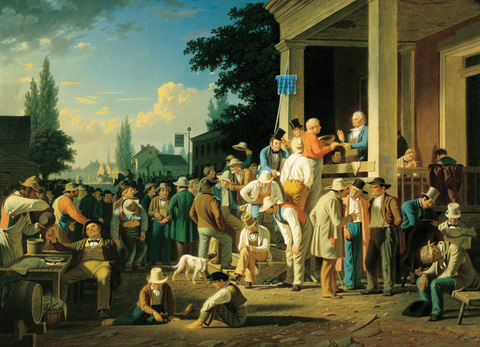
Image: The County Election, 1852 George Caleb Bingham; Source Saint Louis Art Museum
In 1835, Tocqueville published Democracy in America, which identified America's success as being grounded in Christianity. He understood that many were not Christians in early American culture, but the Christians who were genuine made a huge impact of the rest of society. The difference between then and now is how those Christians lived compared to modern-day Christians.
Chris Brauns in his latest Bound Together summarizes Tocqueville's discovery:
"'Tocqueville marveled at the relative absence of government from American life and the corresponding vitality of civil society, especially when compared to the state's all-pervasive presence in his native France.' Tocqueville believed it was Christian values and virtues, what he called 'habits of the heart,' rather than the involvement of government that made for responsible citizens. This, he suggested, was the bedrock of the American experiment.
Tocqueville was not naive about the spirituality of America. He understood that not every citizen was a professing Christian. He was aware of the fact that even among those who professed faith in Christ there was still great hypocrisy. Even so, he noted, 'Revolutionaries in America are obliged to profess a certain public respect for Christian morality and equity, so that it is not easy for them to violate the laws when those laws stand in the way of their own designs. And even if they could overcome their own scruples, they would still be held in check by the scruples of their supporters.'
Tocqueville was especially impressed by the effectiveness of American homes in passing along Christian 'habits of the heart,' and the strength of American homes began with a high regard for marriage: 'Of all the countries in the world, America is surely the one in which the marriage bond is most respected, and in which people subscribe to the loftiest and most just ideal of conjugal happiness.'
Tocqueville believed that mothers, in particular, deserved high praise for teaching Christian values to their children...Tocqueville wrote, 'If someone were to ask me what I think is primarily responsible for the singular prosperity and growing power of [Americans], I would answer that it is the superiority of their women.'
Christian 'habits of the heart,' instilled by godly parents living together in committed marriages, had given rise to a citizenry with a strong sense of civic responsibility and solidarity with one another." (p. 166).
The Christians from two centuries ago were salt and light in their nation. They didn't withdraw completely from the world or throw up their hands in bitter, what-can-I-do-anyway defeat. They didn't strive to be politically correct at all costs so as not to offend someone, to turn a blind eye or gently re-label sin a "choice."
The effects of early American Christianity were similar to a circle of dominoes, one causing another and then another to fall, although in this time period, they fell in a positive way.
Consider the links mentioned in the above quotation. Early American government was small and not intrusive because Christian morality was high (so high that even non-Christians stayed in line). Christian morality was high because marriages were of utmost importance, making the home stable. Because marriages were of utmost importance, parents were able not just to teach Christian values in the home but to live out those Christian values in front of their children. Christian values, then, became ingrained in the children, thereby making Christian morality high in the overall country. See the loop?
America at its greatest begins with mothers and fathers. It begins in the home. It begins with Christians teaching and living out Biblical morality in front of their children. It begins with Christians refusing to lock themselves inside their churches and homes and, instead, getting out into the world to let their light shine before men.
I'm not pointing a finger. I'm speaking to myself, too. There's nothing I'd rather do than stay on my farm, spend time with my family, or worship at church with my spiritual family. Those are safe places that encourage me in my Christian walk. But it's not just about me. It is about a nation, a world full of lost people making wrong, sinful choices...and many of them have no idea they're doing anything wrong.
With Mother's Day just yesterday, I can't help but take Tocqueville's analysis of America and say, if we want our country back, the buck stops with the Christian mother and father. We Christian parents must (1) save our families at all costs. Divorces because of 'irreconcilable differences' or 'we just fell out of love' must stop with us. And (2) we parents must teach and live out Christian values to and before our children.
Like the Israelites in the Old Testament, we are literally one generation away from godliness or godlessness.
(I know this is a bit different from my usual post, but the last chapter in Brauns' book has really convicted me, staying forefront in my mind an entire week. It has made me reevaluate my role as a Christian mother.)
Image: The County Election, 1852 George Caleb Bingham; Source Saint Louis Art Museum
Labels:
Alexis de Tocqueville,
Bound Together,
Chris Brauns,
divorce,
family,
morality,
salt and light,
values
Subscribe to:
Posts (Atom)