Showing posts with label divorce. Show all posts

Sunday, July 6, 2014

The Difference Hope Can Make in Your Marriage

This week, my children have been memorizing Jeremiah 29:11: "'For I know the plans I have for you,' declares the Lord, 'plans to prosper you and not to harm you, plans to give you hope and a future.'"

I've always focused on the beginning and ending phrases in this passage--(1) that the Lord knows all that will happen to me and (2) that He desires a prosperous future for me.  

Such promises go hand in hand with Paul's words: "And we know that in all things God works for the good of those who love him" (Rom. 8:28). 

Somehow, though, I've skipped over the middle part of Jeremiah's promise--"to give you hope."  I've never perceived hope as an important gift from God, but all one need do is seriously imagine a life without hope, and its necessity becomes clear.

Consider living each day with no hope that things would ever get better in your life--no hope for a better job, no hope that your children would mature into productive adults, no hope that your marriage would be happier, no hope in a future beyond this life.  

Imagine a hopeless existence where you must admit to yourself, "This is as good as it gets." Even those who would admit being happy with their lives in general still live with hope, if not for themselves than for a better world.

Paul explains how hope is a lot like faith, in believing in the unseen: "For in hope we have been saved, but hope that is seen is not hope; for who hopes for what he already sees? But if we hope for what we do not see, with perseverance we wait eagerly for it" (Rom. 8:24-25).

God gives us hope to carry us through those hard nights and days.  Perhaps it is not a hope for a perfect life here on earth, but it is always a hope for an eternal future in Christ.  

Without hope, it is too easy to accept defeat.  Nowhere is this most clear to me than in the realm of marriage.  

In Shaunti Feldhahn's newest book: The Good News About Marriage: Debunking Discouraging Myths About Marriage and Divorce, she argues the greatest threat to the modern marriage is not divorce but lack of hope.  

She writes,"You've probably heard the grim facts: Half of all marriages end in divorce. The divorce rate inside the church is the same as outside. And, most marriages are just holding on. But what if these 'facts' are actually myths."

Feldhahn then breaks these myths down, explaining how they came about in the first place, such as the 50% divorce rate being based on projected divorces instead of actual measured divorces. In other words, what we have told to be facts are just assumptions--and faulty ones at that. 

According to Feldhahn's research, 72% of married people are still married to their first spouse (p. 21). What's more, 80% of all marriages are happy (p. 44).  

Interestingly enough, even unhappy marriages can have hope.  Feldhahn writes, "Two out of three unhappily married adults who avoided divorce or separation ended up happily married five years later...Among those who rated their marriages as very unhappy, almost eight out of ten who avoided divorce were happily married five years later" (p. 53).

Such statistics are incredibly encouraging, offering hope that things will get better in even an unhappy marriage.

The most empowering part of this short book, though, deals with Christianity and marriage.  I've been discouraged in the past by the Barna study that showed the divorce rate being the same for Christians as non-Christians, but Feldhahn explains the Barna researchers only studied "those who professed to hold Christian beliefs, not those who went to church" (p. 67).  In essence, a person could have been a Christian in name only and still have been stuck in the "Christian" category.

Feldhahn's research, however, studied those who were active in their faith and discovered that "weekly church attendance alone lowers the divorce rate significantly--roughly 25 to 50 percent" (p. 67).    

What's more, "couples who go to church or other religious services together on a regular basis have the lowest divorce rate of any group studied, regardless of other factors such as how long they've been married" (p. 74).  In short, nominal Christianity may not make a difference in a person's marriage, but active Christianity definitely does.

While not everything in Feldhahn's book is encouraging (for instance, 74% of first unions now live together before marriage), the bulk of her findings are well worth both Christians and non-Christians taking note of.  Despite the bad news the media constantly feeds us about marriage, the truth is more encouraging.  

Consider how these lies impact our view of marriage.  Even in the church, there is a sense of hopelessness concerning the state of marriage in America, the opposite of what God intends us to have, especially in a heart devoted to Him. 

Consider the impact hope can have upon your marriage and my marriage.  If a couple believes half of marriages fail, then they are predisposed to be less hopeful about their own marriage.  When hard times come, they tell themselves divorce was statistically bound to happen anyway.  However, if that same couple believes most marriages do make it, then that hope will propel them to work harder to ensure their marriage survives.

It's the promise of hope.  It's the power of hope.   

Pass it on.

Divorce isn’t the greatest threat to marriage. Discouragement is.

You’ve probably heard the grim facts: Half of all marriages end in divorce. The divorce rate inside the church is the same as outside. And, most marriages are just holding on. But what if these “facts” are actually myths?
- See more at: http://www.shaunti.com/book/good-news-marriage/#sthash.GACgTGzp.dpuf

Divorce isn’t the greatest threat to marriage. Discouragement is.

You’ve probably heard the grim facts: Half of all marriages end in divorce. The divorce rate inside the church is the same as outside. And, most marriages are just holding on. But what if these “facts” are actually myths?
- See more at: http://www.shaunti.com/book/good-news-marriage/#sthash.GACgTGzp.dpuf
Monday, May 13, 2013

Habits of the Heart: A Look at 1830s America

Alexis de Tocqueville left France for America in 1831.  His quest?  To determine why democracy had succeeded in the United States so he might apply those secrets back in his homeland.  What he found was quite enlightening.

In 1835, Tocqueville published Democracy in America, which identified America's success as being grounded in Christianity.  He understood that many were not Christians in early American culture, but the Christians who were genuine made a huge impact of the rest of society.  The difference between then and now is how those Christians lived compared to modern-day Christians.

Chris Brauns in his latest Bound Together summarizes Tocqueville's discovery:

"'Tocqueville marveled at the relative absence of government from American life and the corresponding vitality of civil society, especially when compared to the state's all-pervasive presence in his native France.'  Tocqueville believed it was Christian values and virtues, what he called 'habits of the heart,' rather than the involvement of government that made for responsible citizens.  This, he suggested, was the bedrock of the American experiment.  
      Tocqueville was not naive about the spirituality of America.  He understood that not every citizen was a professing Christian. He was aware of the fact that even among those who professed faith in Christ there was still great hypocrisy.  Even so, he noted, 'Revolutionaries in America are obliged to profess a certain public respect for Christian morality and equity, so that it is not easy for them to violate the laws when those laws stand in the way of their own designs.  And even if they could overcome their own scruples, they would still be held in check by the scruples of their supporters.'
      Tocqueville was especially impressed by the effectiveness of American homes in passing along Christian 'habits of the heart,' and the strength of American homes began with a high regard for marriage: 'Of all the countries in the world, America is surely the one in which the marriage bond is most respected, and in which people subscribe to the loftiest and most just ideal of conjugal happiness.'
      Tocqueville believed that mothers, in particular, deserved high praise for teaching Christian values to their children...Tocqueville wrote, 'If someone were to ask me what I think is primarily responsible for the singular prosperity and growing power of [Americans], I would answer that it is the superiority of their women.'
      Christian 'habits of the heart,' instilled by godly parents living together in committed marriages, had given rise to a citizenry with a strong sense of civic responsibility and solidarity with one another." (p. 166).

The Christians from two centuries ago were salt and light in their nation.  They didn't withdraw completely from the world or throw up their hands in bitter, what-can-I-do-anyway defeat.  They didn't strive to be politically correct at all costs so as not to offend someone, to turn a blind eye or gently re-label sin a "choice."

The effects of early American Christianity were similar to a circle of dominoes, one causing another and then another to fall, although in this time period, they fell in a positive way.

Consider the links mentioned in the above quotation.  Early American government was small and not intrusive because Christian morality was high (so high that even non-Christians stayed in line).  Christian morality was high because marriages were of utmost importance, making the home stable.  Because marriages were of utmost importance, parents were able not just to teach Christian values in the home but to live out those Christian values in front of their children.  Christian values, then, became ingrained in the children, thereby making Christian morality high in the overall country.  See the loop?

America at its greatest begins with mothers and fathers.  It begins in the home.  It begins with Christians teaching and living out Biblical morality in front of their children.  It begins with Christians refusing to lock themselves inside their churches and homes and, instead, getting out into the world to let their light shine before men.

I'm not pointing a finger.  I'm speaking to myself, too.  There's nothing I'd rather do than stay on my farm, spend time with my family, or worship at church with my spiritual family.  Those are safe places that encourage me in my Christian walk.  But it's not just about me.  It is about a nation, a world full of lost people making wrong, sinful choices...and many of them have no idea they're doing anything wrong.

With Mother's Day just yesterday, I can't help but take Tocqueville's analysis of America and say, if we want our country back, the buck stops with the Christian mother and father.  We Christian parents must (1) save our families at all costs.  Divorces because of 'irreconcilable differences' or 'we just fell out of love' must stop with us.  And (2) we parents must teach and live out Christian values to and before our children.

Like the Israelites in the Old Testament, we are literally one generation away from godliness or godlessness.


(I know this is a bit different from my usual post, but the last chapter in Brauns' book has really convicted me, staying forefront in my mind an entire week.  It has made me reevaluate my role as a Christian mother.)

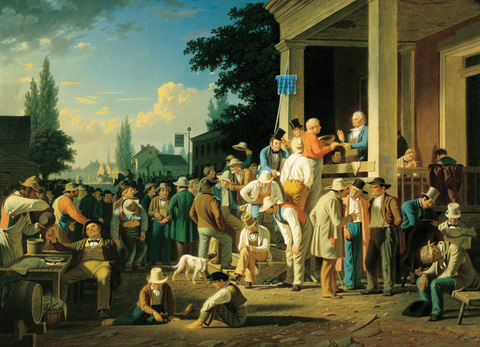
Image: The County Election, 1852 George Caleb Bingham; Source Saint Louis Art Museum